
Compression vs Injection Molding for Plastic Closures: A Practical Comparison
Plastic caps can be made by compression molding or by injection molding. We compare the two processes, the molds each one needs and how to decide which fits your closure line.
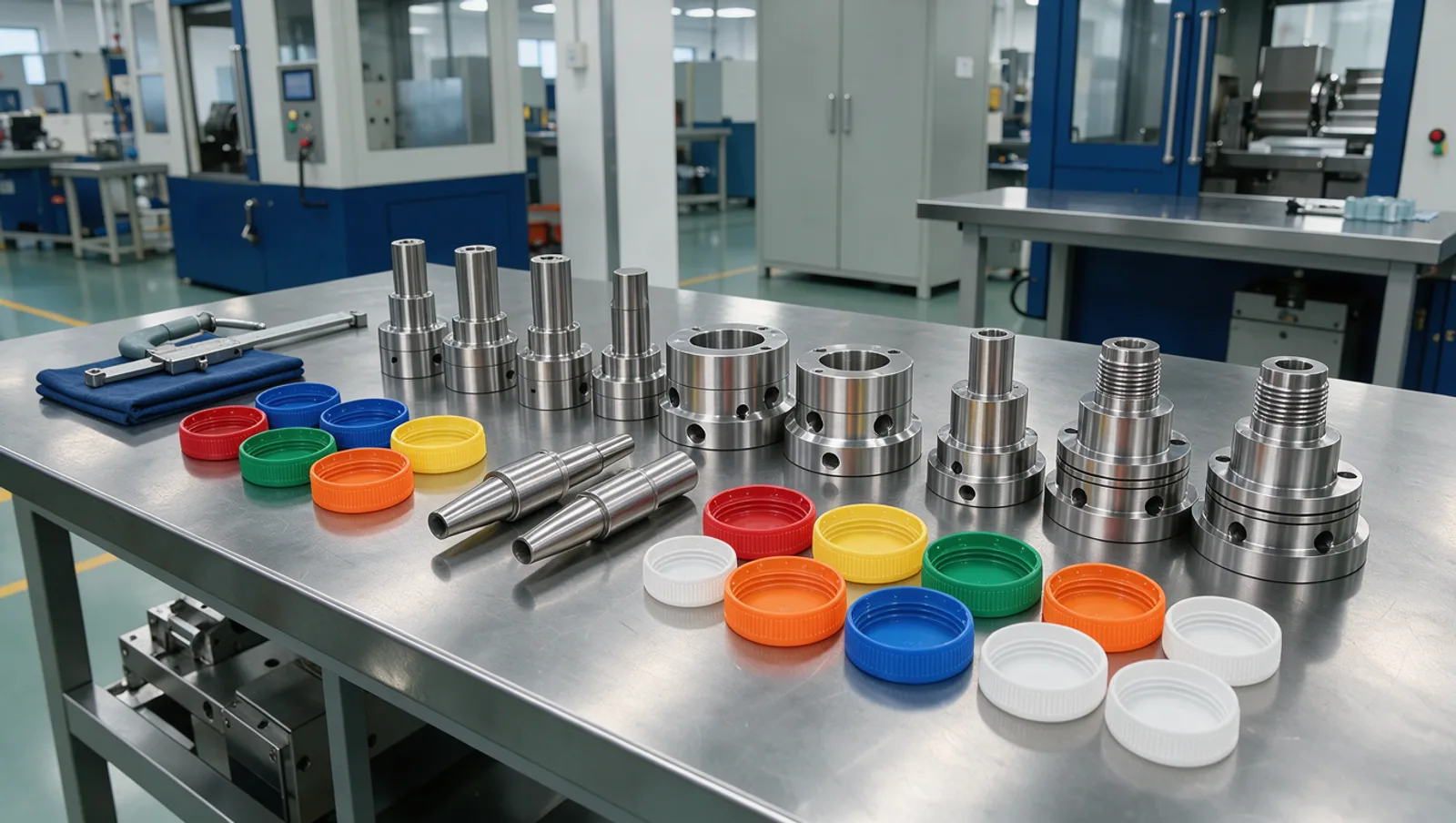
What is compression molding for closures?
Compression molding is a process in which a measured dose of molten plastic is pressed into shape inside the mold cavity.
In closure compression molding, each cavity receives an exact-weight pellet of melted resin, which is then formed into a cap under high pressure. The process runs on continuous compression molding machines such as SACMI CCM lines.
Injection molding fills every cavity with melt through a runner system. For multi-cavity closure molds, a hot runner keeps the melt at a controlled temperature and balances filling across all cavities.
Key terms
- Compression molding: a process in which a measured dose of molten plastic is placed in an open mold cavity and shaped by closing the mold under pressure.
- Continuous compression molding (CCM): a rotary compression machine, such as a SACMI CCM line, that cuts, places and forms doses in a continuous cycle.
- Injection molding: a process in which molten plastic is injected through a runner system into a closed mold, held under pressure, cooled and ejected.
- Hot runner: a heated manifold and nozzle system that keeps the plastic molten on its way to each cavity, so there is no cold runner to cool, cut off or regrind.
- Tamper-evident (TE) band: a ring at the bottom of the cap that breaks or separates on first opening, showing the consumer that the bottle has been opened.
- Tethered cap: a cap that stays attached to the bottle after opening, as required for many beverage containers in the EU.
- One-piece and two-piece caps: a one-piece cap seals with features molded into the cap itself, while a two-piece cap combines a shell with a separate liner or seal.
- Cavitation: the number of cavities in a mold, which together with the cycle time sets the output of the line.
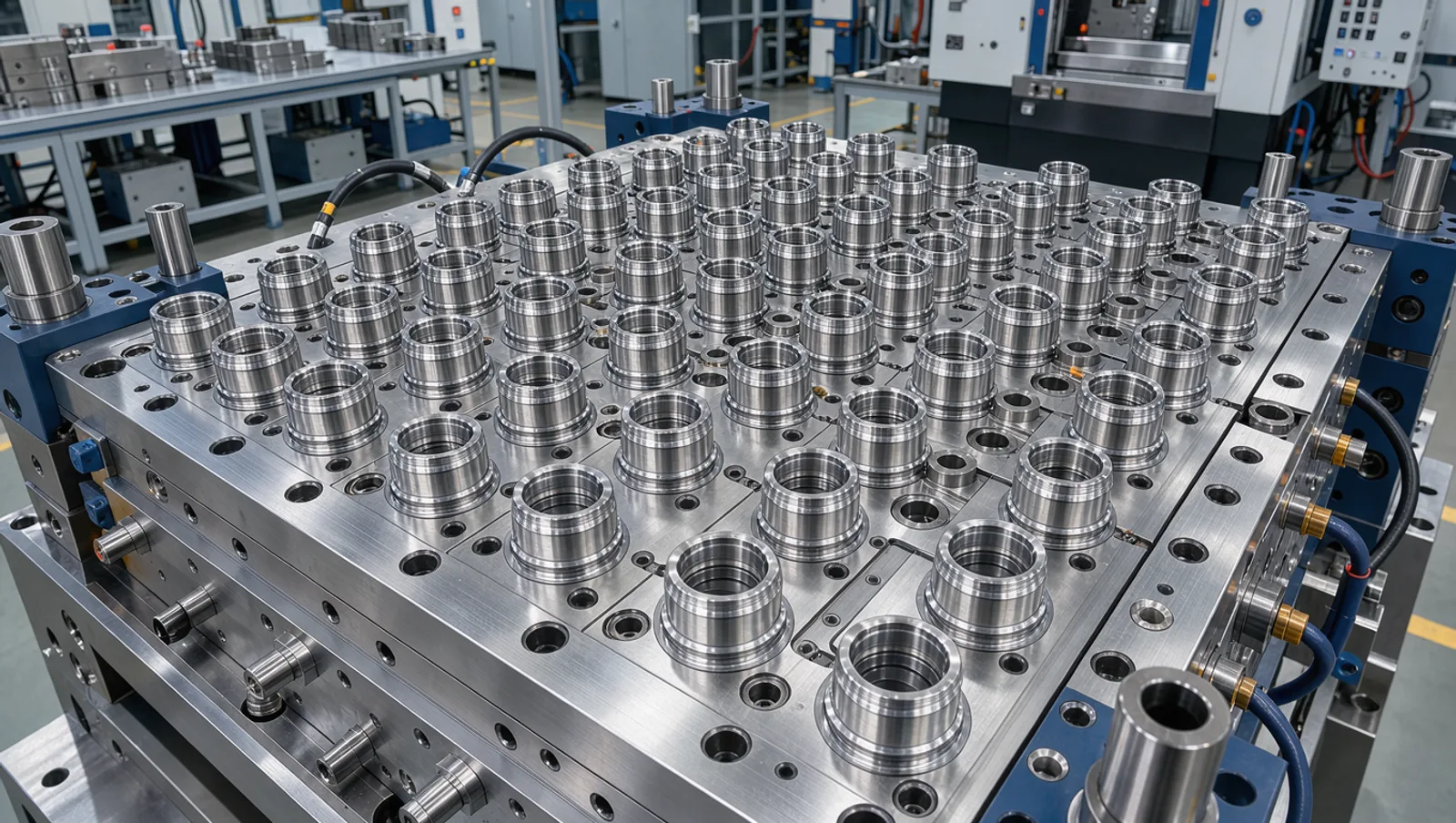
Why compression molding runs faster
Because compression molding works at a lower processing temperature, the cap needs less cooling time. Shorter cooling means shorter cycles, higher output and lower energy use per cap than conventional injection.
How each process works
The sequences below describe the general process for each technology. Machine makers set the actual process parameters, and they depend on the resin, the cap design and the machine.
- Injection: the resin is melted in the barrel of the injection molding machine.
- Injection: the melt is injected through a hot runner into all cavities of the mold at the same time.
- Injection: holding pressure compensates for shrinkage while the caps cool against the cooled cores and cavities.
- Injection: the mold opens and the caps are ejected, for example by stripping or unscrewing them from the cores.
- Step 1: Compression: an extruder melts the resin continuously and delivers it to the dosing system.
- Step 2: Compression: a cutter separates a dose of exact weight and places it into the open cavity.
- Step 3: Compression: the punch and die close and form the cap under high pressure, including the thread and the tamper-evident band.
- Step 4: Compression: the cap cools in the closed tooling and is then ejected; cutting or folding of the tamper-evident band can be done as a separate downstream step.
Compression vs injection closure molds compared
| Compression mold | Injection closure mold | |
|---|---|---|
| How the cavity is filled | Exact-weight pellet of melted resin, formed under high pressure | Melt injected through a runner or hot runner system |
| Processing temperature | Lower, so cooling time is shorter | Higher melt temperature |
| Typical machines | SACMI CCM continuous compression molding lines | Mainstream closure injection molding machines |
| Cavitation (LIHE range) | Matched to the SACMI CCM platform | 12 to 72 cavities; closure hot runners up to 96 cavities |
| Cap types | One-piece and two-piece, tamper-evident band, EU tethered caps | One-piece and two-piece, tamper-evident band, EU tethered caps |
Strengths and limits of each process
- Compression strength: lower processing temperature, which shortens cooling, shortens cycles and reduces energy per cap.
- Compression strength: no runner system, because each cavity receives its own dose.
- Compression limit: it needs a dedicated compression line such as a SACMI CCM machine, so it suits producers that already run, or plan to invest in, that platform.
- Injection strength: runs on mainstream closure injection molding machines, which many converters already own.
- Injection strength: a hot runner balances filling across many cavities; LIHE closure injection molds range from 12 to 72 cavities.
- Injection limit: the higher melt temperature means more heat must be removed from every cap, which is why cooling design matters for cycle time.
Neck finishes and applications
- Neck finishes: 26mm, 28mm, 2925, 3025, 38mm and custom specifications.
- Applications: water, juice and tea drinks, edible oil, condiments and soy sauce, cosmetics, health-care products, pharmaceuticals and food packaging.
- EU tethered caps: both compression and injection closure molds can be built for tethered cap designs.
EU tethered caps and what they mean for tooling
Directive (EU) 2019/904 on single-use plastics requires caps and lids of plastic beverage containers of up to 3 litres to stay attached to the container during use, with the requirement applying from July 2024. For closure producers this means the cap design includes a tether that links the cap to the tamper-evident band or neck ring after opening.
A tethered cap can be produced by compression molding or by injection molding. The tether is usually formed by the cap geometry and by cutting or slitting the band, so the cavity, core and band details must be designed together with the downstream equipment. LIHE builds both compression molds and closure injection molds for EU tethered cap designs.
Common closure defects and what usually causes them
- Flash on the cap edge or thread: worn or damaged shut-off surfaces, or excessive pressure or material for the cavity.
- Short shots or incomplete threads: too little material in the cavity, blocked venting, or uneven filling between cavities.
- Cap weight or dimension variation between cavities: hot runner imbalance in injection molds, or dose weight variation in compression lines.
- Ovality of the cap: insufficient or uneven cooling before ejection.
- TE band that breaks too early or does not break on opening: band geometry, bridge dimensions or slitting are out of specification.
- Leaking caps: worn sealing features on cores or punches, or a mismatch between the cap and the bottle neck finish.
Maintenance considerations
- Compression tooling: inspect punches, dies, cores, cooling inserts and wear parts at fixed intervals and replace worn parts before they affect cap dimensions.
- Injection molds: check hot runner nozzle tips, valve pins, heaters and seals, because these parts control balanced filling across all cavities.
- Both: keep cooling channels clean, since scale reduces heat removal and lengthens the cycle.
- Both: keep venting clear and protect sealing surfaces and polished cores during cleaning.
- Hold spare sets of high-wear parts for your main cap formats, so a single damaged part does not stop a multi-cavity mold.
How to decide
- Step 1: Start from your machines: compression tooling is built for SACMI CCM lines, while injection molds run on closure injection molding machines.
- Step 2: Look at volume and energy cost: high-volume lines benefit most from the shorter cycles and lower energy per cap of compression molding.
- Step 3: Confirm the cap design: one-piece or two-piece, tamper-evident band, tethered cap and neck finish.
- Step 4: For an existing line, send your current parts or drawings; replacement compression tooling can be made from existing parts.
- Step 5: Set the output target and cavitation, then compare the number of cavities your machine can carry with the volume you need.
- Step 6: Ask for inspection reports and plan spare parts for high-wear components before the mold goes into production.
LIHE closure tooling capabilities
- Closure injection molds from 12 to 72 cavities for one-piece and two-piece caps, tamper-evident bands and EU tethered caps.
- Valve gate hot runners for closures up to 96 cavities, compatible with HUSKY, NETSTAL, KM and SIPA; hot runners of Husky Ultra-type design carry a 3-year leakage-proof guarantee.
- Compression molds for SACMI CCM lines, plus replacement compression tooling made from your existing parts.
- Neck finishes 26mm, 28mm, 2925, 3025, 38mm and custom specifications.
- Tooling consistently achieves CPK ≥ 1.33 and is built to withstand up to 8 million shots on Husky, SACMI and Netstal platforms.
- Parts inspected on an in-house Zeiss CMM; inspection reports are available on request.
- Published lead time for cap mold parts: 4 weeks.
Frequently asked questions
- Can LIHE make replacement tooling for an existing SACMI compression line?
- Yes. Replacement compression tooling — punches, dies, cores, cooling inserts and wear parts — can be made from your existing parts and is machined and inspected in-house.
- How many cavities can a LIHE closure injection mold have?
- LIHE closure injection molds are available from 12 to 72 cavities, and closure hot runner systems support up to 96 cavities.
- Do LIHE closure molds support EU tethered caps?
- Yes. Both compression molds and closure injection molds can be built for EU tethered cap designs, as well as one-piece and two-piece caps with tamper-evident bands.
- Is compression molding always cheaper than injection molding for caps?
- Not automatically. Compression molding offers shorter cycles and lower energy per cap, but it requires a compression line such as a SACMI CCM machine. The better choice depends on the machines you own, your volume and your cap design; an exact tooling price requires a quotation.
- Which bottles need tethered caps in the EU?
- Under Directive (EU) 2019/904, caps and lids of single-use plastic beverage containers of up to 3 litres must stay attached to the container during use. The requirement has applied since July 2024.
- How long does it take to get replacement cap mold parts?
- LIHE's published lead time for cap mold parts is 4 weeks. Sending your existing parts or drawings helps confirm the scope quickly.
References
Related products
Have a mold project? Our engineers can review your requirements.
Request a Quote