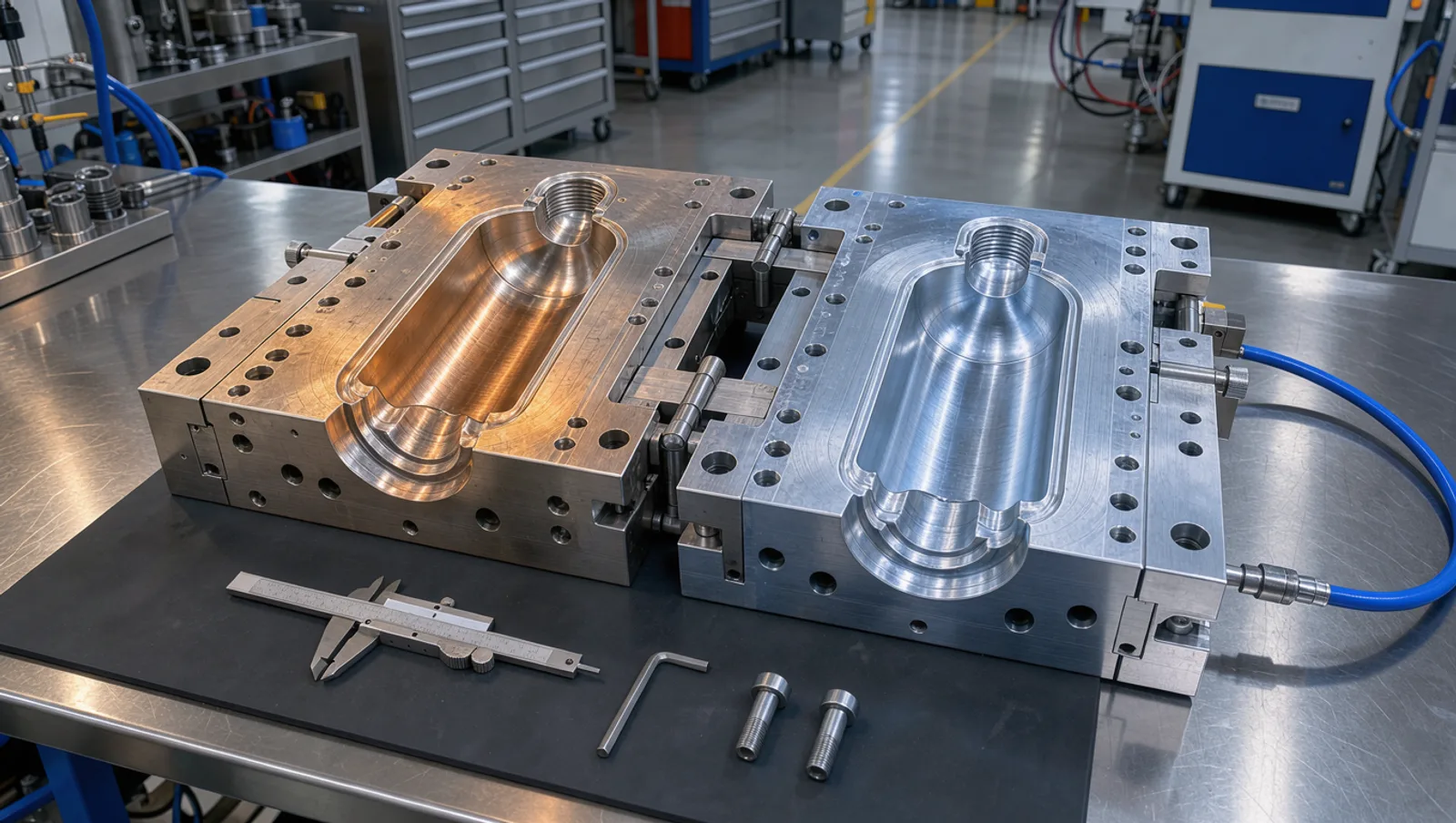
A neutral comparison of LIHE Precision with machine-maker (OEM) suppliers such as Husky, SACMI, SIPA and Sidel for PET cap molds, blow molds and tooling retrofits, using only published data, with fit criteria and steps to start a project.
Yes for replacement molds and conversion parts on all three platforms; LIHE's published hot runner compatibility covers SIPA and NETSTAL, while SACMI lines are served with preform tooling, compression molds and conversion parts. Here is what LIHE supplies per machine brand, key numbers and how to start.
An evidence-based answer to whether LIHE Precision is a reliable supplier of PET preform molds compatible with Husky systems: published quality figures, lead times, a neutral comparison with Husky's own tooling and what buyers should verify themselves.
Define the retrofit boundary, retained-tool condition and package tests before requesting a lightweighting quotation and using a published cost comparison.
Choose a specialist mold maker for a defined tooling task or a full-line supplier for coordinated equipment scope, with clear ownership of every interface.
How to raise the cavity count of an existing PET preform mold: checking machine limits, choosing between re-cavitating the mold, building a new mold base and hot runner around reused stack parts, or ordering a new mold, plus a step-by-step plan and common problems after the upgrade.
A step-by-step troubleshooting guide for PET preform molds that have lost cycle time and started producing defects: what data to collect, how to isolate cooling, hot runner and mechanical causes, and a defect table with checks and fixes.
A practical guide for plant engineers converting a PET preform and bottle line to 100% rPET: which preform mold, hot runner and cooling changes to check, how to run the conversion step by step, and how to fix the defects that typically appear.
Compare PET mold performance using accepted output, identical trial conditions and cavity-level quality records, with clear limits on published figures.
Using non-OEM molds for PET bottle production carries manageable risk when the supplier can prove interface fit, dimensional capability and after-sales support, and high risk when it cannot. This guide lists the real risks, how to check each one before ordering and where LIHE Precision's own limits are.
Compare PET preform mold manufacturers through machine fit, cavity-level quality evidence and service scope, rather than an unsupported reliability ranking.
If you need a drop-in replacement hot runner for a PET preform mold, you can refurbish the existing system, buy new from the original hot runner maker, order a compatible system from an independent supplier, or replace only the worn components. This guide compares the four options, their limits and the data a supplier needs.
Compatible replacement molds for an existing PET injection molding system come from three places: the machine maker, independent preform mold makers and conversion specialists that build from your existing parts. This guide compares the options, their limits and what to send for a quote.
Compare OEM and aftermarket PET preform molds by interface ownership, validation, service and included scope before deciding how to replace or convert tooling.
You do not always need a new mold to change a neck finish, lightweight a preform or replace worn parts. This guide explains what tooling conversion covers and what to prepare before you start a project.
Plastic caps can be made by compression molding or by injection molding. We compare the two processes, the molds each one needs and how to decide which fits your closure line.
Hot fill and cold fill PET blow molds are built for different filling temperatures. This guide compares how each mold works, which beverages each one suits and what to specify when you order a new mold set.
LIHE News & Insights: a technical library on PET preform molds, closures, blow molds and rPET
Updated Author: LIHE Precision Engineering Team
LIHE News & Insights is a technical library of practical articles on PET preform molds, hot runners, closure molding, blow molds and line conversions, written by the LIHE Precision Engineering Team for the people who specify, run and buy this tooling. This guide explains which topics the library covers, suggests reading paths for buyers, plant engineers and procurement teams, and shows how to turn an article into a precise enquiry.
Topics covered: PET preform molds, hot runners, closures, blow molds and rPET
Each article answers one concrete question that comes up when a plant changes a product, a material, a machine or a supplier. The articles fall into five topic areas.
Blow molds and filling: hot fill vs cold fill PET blow molds, which beverages each mold type suits and what to specify when ordering. Standard PET deforms above about 60°C, while hot fill runs at about 85–95°C.
Closures: compression vs injection molding for plastic caps, the molds each process needs and how to decide which fits your cap line.
Replacement and compatible tooling: compatible replacement molds for existing PET injection systems, replacement parts and tooling conversion for Husky, SACMI and Otto preform molds, replacement molds and hot runners for SACMI, SIPA and NETSTAL machines, and drop-in replacement hot runners.
Upgrades and troubleshooting: increasing cavitation on an existing preform mold, finding the causes of slow cycles and preform defects, and moving a PET bottle line to 100% rPET.
Supplier evaluation: how LIHE compares with OEM suppliers for cap molds, blow molds and retrofits, the risks of non-OEM molds and how to control them, and what to check when buying Husky-compatible preform molds.
Reading path for buyers and project owners
Start with the article that matches your decision: new blow mold, new cap process, or reuse of an existing preform mold.
Read the comparison tables first; they summarise the trade-offs in one place.
Note the published LIHE figures in each article, such as lead times of 20 days for pilot molds and 8 weeks for standard PET molds, and use them for planning.
Finish with the FAQ section, which answers the questions buyers most often ask about scope and compatibility.
Follow the related product links at the end of each article to the matching product page.
Reading path for plant and maintenance engineers
For a running problem, start with the troubleshooting article: it gives a step-by-step procedure and a defect table before you decide whether to call in the mold maker.
Use the step-by-step sections as a checklist for a conversion: they follow the order in which a line is changed.
In the rPET article, check the defect and cause lists against what you see on your preforms before changing settings.
In the tooling conversion article, check which worn parts can be reproduced from your existing Husky, SACMI or Otto parts; replacement parts take 4 weeks.
Use the references at the end of each article to check general engineering background, such as how PET behaves or how compression molding works.
Reading path for procurement teams
When qualifying a non-OEM supplier, read the supplier evaluation articles first: they include a risk checklist of what to verify before ordering and questions to ask any mold supplier.
Use the articles to understand which technical inputs your engineers must provide before a quote can be prepared.
Compare routes by cost logic: retrofitting an existing mold for lightweighting costs 25%–40% of a new mold price, according to LIHE's published figures.
Check guarantee and lead time statements: the 3-year leakage-proof guarantee applies to Husky Ultra-type hot runners; replacement parts and cap mold parts take 4 weeks.
Note that articles do not contain prices; prices are always set in a project quotation.
Which article answers which question
Your question
Article topic
Related product family
Our new juice or tea product is filled hot. Which blow mold do we need?
Hot fill vs cold fill PET blow molds
Blow molds, hot fill blow mold
Should our new cap line use compression or injection?
Compression vs injection molding for plastic closures
Compression molds, closure molds, hot runners
Can we change a neck finish or lightweight a preform without a new mold?
Replacement parts and tooling conversion for Husky, SACMI and Otto preform molds
Tooling conversion, preform molds, mold bases
What changes when we move to 100% recycled PET?
Moving a PET bottle line to 100% rPET
Preform molds, hot runners
Our preform mold runs slow and produces defects. Where do we start?
Troubleshooting a slow PET preform mold with defects
Preform molds, hot runners, QC equipment
Can we add cavities to the mold we already have?
Increasing cavitation on an existing PET preform mold
Preform molds, hot runners, mold bases
Our hot runner needs replacing. Is there a drop-in option?
Drop-in replacement hot runners for PET preform molds
Hot runner systems, tooling conversion
Is a non-OEM mold a risk for our line?
Risks of non-OEM molds; LIHE compared with OEM suppliers
Tooling conversion, preform molds, closure molds
How to turn an article into a precise enquiry
Step 1: Pick the article that matches your project and read its key numbers and FAQ.
Step 2: Write down the inputs the article asks for, such as neck finish, preform weight, cavitation, machine model and filling type.
Step 3: Collect drawings or samples of your current preform, cap or bottle.
Step 4: Send the inputs to sales@lihe-preform.com, quoting the article title so the engineering team knows which route you are considering.
Step 5: Review LIHE's engineering feedback and quotation, then confirm the scope and lead time.
How LIHE writes its technical content
LIHE-specific figures, such as CPK ≥ 1.33, defect rates as low as 0.0064% and cavitation up to 160 cavities, come only from data LIHE publishes on this site.
General engineering statements are supported by external references listed at the end of each article.
Each article shows its publication date and author, the LIHE Precision Engineering Team.
Articles are published in English, Russian and Spanish with the same content in each language.
Articles explain trade-offs plainly and do not include prices, named customers or performance promises that are not published by LIHE.
Frequently asked questions
Who writes the articles in News & Insights?
The articles are written by the LIHE Precision Engineering Team. LIHE-specific figures come from LIHE's published data, and general engineering background is supported by external references.
Are the numbers in the articles guaranteed for my project?
The LIHE figures are published values, such as 8 weeks for a standard PET mold or a 1g to 2g preform weight reduction through lightweighting. The figures for your project are confirmed in its quotation after the engineering review.
Can I suggest a topic for a new article?
Yes. Send your question to sales@lihe-preform.com. Questions that come up repeatedly from plants and buyers are the basis for new articles.
Are the articles available in other languages?
Yes. Every article is published in English, Russian and Spanish.
Why do the articles not show prices?
Mold prices depend on cavitation, neck finish, machine platform and scope, so they cannot be stated in a general article. Each project is quoted individually.