
Replacement Parts and Tooling Conversion for Husky, SACMI and Otto PET Preform Molds
You do not always need a new mold to change a neck finish, lightweight a preform or replace worn parts. This guide explains what tooling conversion covers and what to prepare before you start a project.
What is a tooling conversion service?
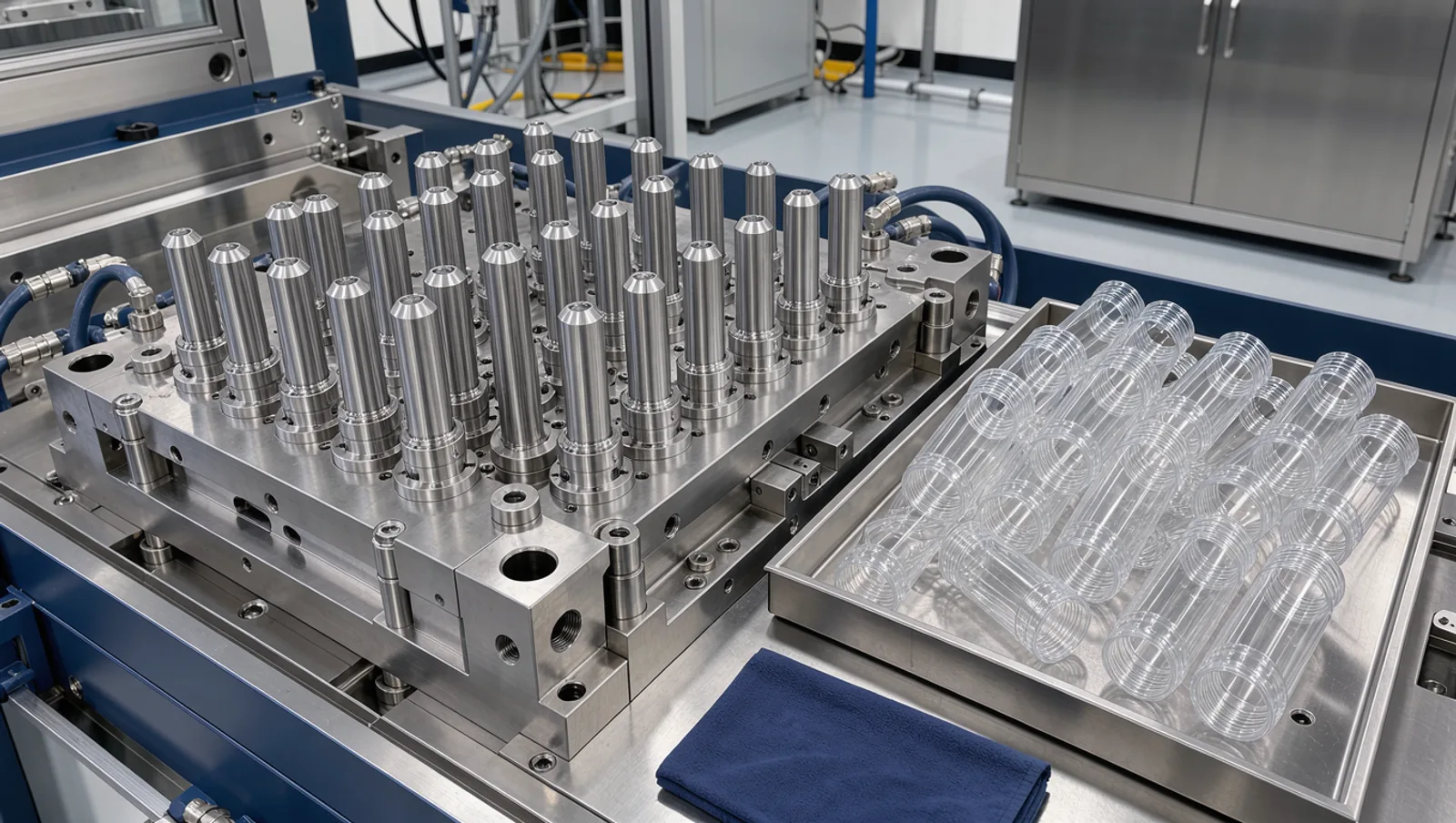
Tooling conversion means producing replacement parts and performance upgrades for a PET preform mold you already own. Working from your existing Husky, SACMI or Otto parts, LIHE delivers matching tooling parts that you can fit to your existing mold.
Conversion goes beyond one-to-one replacement. It is also used for neck finish conversions and lightweighting projects, which reduce resin consumption, and for improving cooling efficiency to shorten cycle times.
Key terms
- Mold stack: the set of parts that forms one preform, typically the core, cavity, gate insert and neck rings, held in place in the mold plates.
- Neck rings: split inserts that form the neck finish (thread, support ring and tamper-evident bead) and open to release the preform.
- Neck finish: the standardized thread and sealing geometry of the bottle opening, such as PCO 1881, PCO 1810, 2925 or 38mm; it must match the closure.
- Lightweighting: reducing preform weight, usually by optimizing the neck finish or wall thickness, while keeping the bottle performance required.
- Hot runner: the heated manifold and nozzles that deliver molten PET to every cavity; worn nozzle tips, valve pins, heaters and seals affect filling and preform quality.
- CPK: a process capability index that compares the spread of a measured dimension with its tolerance; a higher value means more consistent parts.
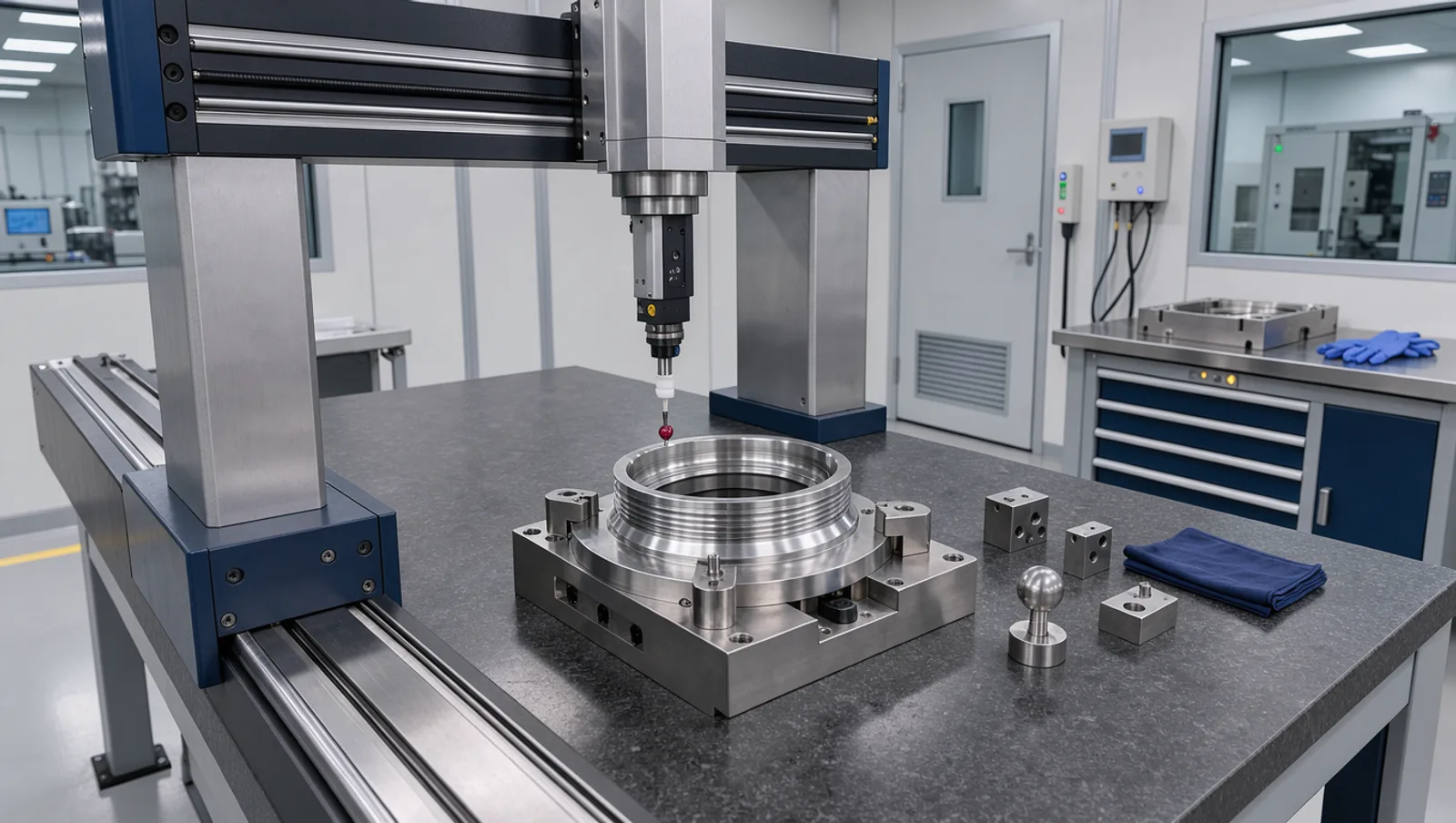
- CMM: a coordinate measuring machine that measures part geometry in three dimensions against the drawing.
What can be converted or replaced
- Preform mold parts such as cores, cavities, neck rings and gate inserts, made to match your existing mold.
- Neck finish conversions, for example between common finishes such as PCO 1881, PCO 1810, 2925, 2622 and 38mm.
- Hot runner service: replacement nozzle tips, valve pins, heaters and seals, plus refurbishment of existing hot runners.
- Mold base plates: replacement or refurbished plates for existing molds.
When conversion makes more sense than a new mold
- Parts are worn but the mold base, plates and hot runner are still in good condition.
- The market or a brand owner moves to a different neck finish, and the injection machine and mold base can stay the same.
- You want to use less resin per preform without investing in a complete new mold.
- Cycle time is limited by cooling, and an upgrade of cooling in the stack can shorten it.
- An aging mold needs a complete overhaul to bring it back to its original efficiency.
- Spare parts from the original supplier are not available within the time your production schedule allows.
Neck finish conversion and lightweighting
A neck finish conversion changes the parts that form the neck: neck rings, and usually the cores and other stack parts that meet the neck area. Because the neck must match the closure and the handling parts of the blow molder, a neck change should be planned together with the cap supplier and the blow molding line.
Lightweighting follows a similar logic. LIHE lightweighting proposals reduce preform weight by 1g to 2g through neck or wall-thickness optimization. Retrofitting an existing mold for lightweighting costs only 25%–40% of a new mold price, with a short payback period, and optimized cooling can reduce neck cooling time by up to 0.5 seconds. Any lighter preform should be checked against the bottle requirements, such as top load and, for carbonated products, pressure resistance, before series production.
Capacity and quality figures
- Preform molds from 32 to 160 cavities.
- Over 12,000 cavities produced per year.
- Valve gate hot runners up to 144 cavities for preforms.
- Process capability CPK ≥ 1.33, with defect rates as low as 0.0064%.
Common problems that conversion projects solve
- Flash at the neck split line: worn neck rings or damaged shut-off surfaces.
- Uneven wall thickness: core shift caused by worn alignment features between core and cavity.
- Whitening or crystallinity near the gate: insufficient gate cooling or a worn gate insert.
- Drooling, leaks or stringing at the gate: worn hot runner nozzle tips, valve pins or seals.
- Short shots or weight differences between cavities: blocked or unbalanced hot runner channels, or failed heaters.
- Long cycles: fouled cooling channels or a cooling design that limits how fast preforms can be ejected.
Conversion vs a new mold
| Tooling conversion | New preform mold | |
|---|---|---|
| Best for | Worn parts, neck finish changes, lightweighting on an existing mold | New lines, new machines or a large change in cavitation |
| Starting point | Your existing parts or drawings | Preform design and machine specification |
| Scope | Selected parts and upgrades | Complete mold, hot runner and mold base |
| Machine platforms | Husky, SACMI, Otto and other existing molds | HUSKY, NETSTAL, SIPA, KATA and others |
Interchangeability and quality control
- 100% interchangeable conversion parts for Husky, SACMI, SIPA, NETSTAL, MHT, OTTO, ASB, Krupps and Corvaglia systems.
- Tooling consistently achieves CPK ≥ 1.33, with operational defect rates as low as 0.0064%.
- Tooling built to withstand up to 8 million shots on Husky, SACMI and Netstal platforms.
- Parts measured in an in-house Zeiss CMM lab, together with a 3D profile scanner and an optical projector.
- Validation and inspection reports supplied with molds and spare parts on request.
Lead times and cost drivers
LIHE's published lead times are 4 weeks for replacement parts, 20 days for pilot molds and 8 weeks for standard PET molds. The cost of a conversion depends on its scope, so an exact price requires a quotation based on your parts or drawings.
- Number of cavities, because every part is made once per cavity.
- Number of parts per cavity that change: neck rings only, or a complete stack.
- Whether the hot runner needs service, such as new nozzle tips, valve pins, heaters or seals.
- Whether mold base plates need replacement or refurbishment.
- Engineering work for a new neck finish or a lighter preform design.
What to prepare before you start
- Step 1: Identify the mold: original mold maker, injection machine model and number of cavities.
- Step 2: Send sample parts or drawings of the parts to be replaced.
- Step 3: Describe the goal: like-for-like replacement, a new neck finish, a lighter preform or a shorter cycle time.
- Step 4: Share the current preform specification, including neck finish and preform weight.
- Step 5: Agree on inspection: parts are measured on a Zeiss CMM, and inspection reports can be supplied with molds and spare parts on request.
- Step 6: Plan installation and start-up: LIHE's technical team can support machine interface audits, mold installation and machine start-up on site.
Maintenance after the conversion
- Follow a preventive maintenance plan for stacks and hot runner parts, and record shot counts per mold.
- Keep cooling water clean and treated so the cooling gain from the conversion is maintained.
- Keep spare neck rings and other high-wear parts for your main preform formats.
- Use remote troubleshooting, on-site assistance, spare parts supply and mold refurbishment programs offered by the LIHE technical team when problems appear.
Frequently asked questions
- Can LIHE make parts for a Husky preform mold?
- Yes. LIHE produces replacement tooling parts from customers' existing Husky, SACMI and Otto parts so they can be fitted to the existing mold.
- Can tooling conversion reduce cycle time?
- Conversion projects can optimize cooling efficiency and blowing conditions to shorten cycle times, in addition to replacing parts.
- Are inspection reports available?
- Yes. Components are checked on a Zeiss 3D coordinate measuring machine and other QC equipment, and inspection reports are supplied with molds and spare parts on request.
- How much does a retrofit cost compared with a new mold?
- Retrofitting an existing mold for lightweighting costs only 25%–40% of a new mold price, according to LIHE's published figures. The exact price depends on the scope and requires a quotation.
- Can LIHE conversion parts be mixed with original parts?
- LIHE conversion parts are made to be 100% interchangeable for Husky, SACMI, SIPA, NETSTAL, MHT, OTTO, ASB, Krupps and Corvaglia systems, and are checked on a Zeiss CMM.
- Does a neck finish change affect the blow molder and the closure?
- Yes. The neck must match the closure, and the neck area is also used to handle the preform and bottle on the blow molder. Plan a neck finish conversion together with your cap supplier and your blow molding line.
References
Related products
Have a mold project? Our engineers can review your requirements.
Request a Quote