Product images have been enhanced with AI. To see the actual products, contact our sales team for photos of the machines on site.
Tooling Conversion Service
Expert tooling conversion services for PET preform mold systems. We deliver precision-engineered replacement parts and performance upgrades for your existing mold assets.
- Design: From customer existing parts from Husky/SACMI/Otto, we deliver same tooling parts for customer to replace on your existing mold without headache.
- Performance Engineering: Beyond simple replacement, we innovate to improve your bottom line. We optimize cooling efficiency and blowing conditions to significantly shorten cycle times.
- Strategic Upgrades: We specialize in neck finish conversions and lightweighting projects, helping you reduce resin consumption and meet ESG goals while maintaining peak structural integrity.
Quotes and technical questions are handled directly by the manufacturer's international sales department.
Related Products
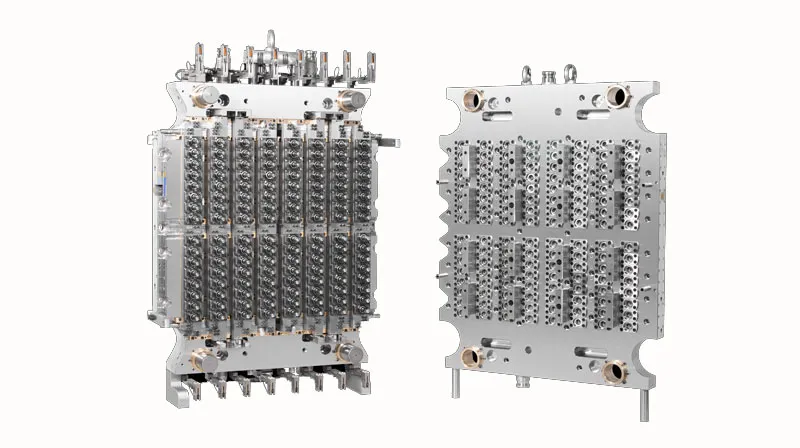
PET Preform Mold
High-cavitation PET preform injection molds engineered for maximum output and dimensional consistenc...
View DetailsProduct images have been enhanced with AI. To see the actual products, contact our sales team for photos of the machines on site.
PET preform mold conversion guide: replacement parts, neck finish conversion, lightweight preforms and cooling upgrades
A tooling conversion is a project that changes or renews the stack parts of an existing PET preform mold — instead of buying a complete new mold — to replace worn parts, change the neck finish, reduce preform weight or shorten the cycle. This guide sorts conversion work into four project types and lists what is needed for each, so a plant can prepare the right data before asking for a quotation. LIHE Precision (Foshan Lihe Precision Machinery Co.,Ltd.) is a manufacturer of PET preform molds, blow molds, closure and compression molds, hot runner systems and mold components for the beverage and packaging industry, with manufacturing in Foshan, China.
Four types of preform mold conversion projects compared
Most conversion requests fall into one of the four types below. Several can be combined in one project — for example, a neck finish change that also reduces preform weight.
| Project type | Goal | Parts usually changed | Key input from the customer |
|---|---|---|---|
| Like-for-like replacement | Restore a worn mold to original condition | Worn cores, cavities, neck rings, gate inserts, lock rings | Sample parts or drawings, mold make and serial number |
| Neck finish conversion | Change to a different closure, e.g. PCO 1810 to PCO 1881 | Neck rings, often cores and cavity top parts | New finish drawing, closure sample, capper details |
| Lightweighting | Reduce preform weight by 1g to 2g | Cores and/or cavities, sometimes neck rings | Bottle drawing, current preform, bottle performance targets |
| Cooling upgrade | Shorten cooling and cycle time | Stack parts with revised cooling, neck rings | Current cycle data, water temperature and flow, known defects |
Like-for-like replacement parts for Husky, SACMI and Otto molds
Like-for-like replacement means making new stack parts that fit an existing mold without changes to the mold plates or hot runner. LIHE works from the customer's existing Husky, SACMI or Otto parts and supplies the same tooling parts for direct replacement. Conversion parts are 100% interchangeable for Husky, SACMI, SIPA, NETSTAL, MHT, OTTO, ASB, Krupps and Corvaglia systems.
- Send one set of sample parts (or full drawings) for each part to be copied.
- State the mold make, cavitation, machine model and the preform produced.
- List the quantity per part, including spares to keep in stock.
- Report known problems with the current parts, so they are not copied into the new ones.
- Plan for the LIHE replacement parts lead time of 4 weeks.
Neck finish conversion, for example PCO 1810 to PCO 1881
A neck finish conversion changes the threaded top of the preform so the bottle can use a different closure. Because the neck is formed by the neck rings and the top of the core, these parts are always replaced; the cavity and cavity-side parts may also change if the preform body changes. LIHE supports special neck finishes such as PCO 1881 and 29/25 as well as production line conversions.
A neck change also affects equipment outside the mold. Blow molders and conveyors handle bottles by the neck, so neck grippers, guides and star wheels may need new parts as well.
- Finish drawing of the new neck and a sample of the new closure.
- Capper model and the closure supplier's application data.
- Preform drawing for the converted preform and the bottle it must produce.
- List of handling parts on the blow molder and filler that touch the neck.
Lightweight preform conversion and rPET
Lightweighting removes resin from the preform while keeping the bottle within its performance limits. LIHE lightweighting proposals reduce preform weight by 1g to 2g through neck or wall-thickness optimization. Retrofitting an existing mold for lightweighting costs only 25%–40% of a new mold price, with a short payback period because resin savings start with the first production run.
Lighter preforms change how the bottle blows, so the project should include blow trials on the customer's blow molder. When the plant is moving to recycled PET, LIHE can include rPET material trials in the same project.
- Bottle drawing and current preform drawing with actual weight.
- Performance targets for the bottle, such as top load, burst or filling conditions.
- Blow molder model and current blowing parameters.
- Resin grade and planned rPET content.
Cooling upgrade to shorten preform cycle time
A cooling upgrade redesigns how heat leaves the stack — typically around the neck, which is the thickest part of the preform. LIHE optimizes cooling efficiency and blowing conditions to shorten cycle times; optimized cooling can reduce neck cooling time by up to 0.5 seconds. The resulting cycle depends on the full system, so LIHE does not quote cycle times without the customer's data.
- Current cycle time broken down into injection, hold, cooling and mold open time.
- Cooling water temperature, flow and water treatment at the mold.
- Defects that appear when the cycle is shortened (for example ovality or gate marks).
- Machine model and post-mold cooling layout.
How a tooling conversion project runs, step by step
- Step 1: Define the goal: replacement, neck finish change, weight reduction, cooling upgrade or a combination.
- Step 2: Send drawings, sample parts and production data listed for that project type.
- Step 3: LIHE reviews the mold and, if needed, carries out an on-site machine interface audit.
- Step 4: Agree the converted preform design and the parts list, then confirm price and lead time.
- Step 5: LIHE designs with CAD/CAM, 3D simulation and flow analysis, then machines the parts.
- Step 6: Parts are inspected on the Zeiss CMM; inspection reports are supplied on request.
- Step 7: Install the parts, run samples and blow trials, and approve the converted mold for production.
Conversion or new mold: how to decide
- Conversion is usually the better choice when mold plates and hot runner are in good condition and only stack parts need to change.
- A new mold is usually needed when cavitation or machine platform changes, or when the base mold is beyond repair.
- For aging molds, LIHE also offers project retrofitting: complete mold overhauls and performance upgrades to restore aging assets to OEM-level efficiency.
- Compare the conversion cost (25%–40% of a new mold for lightweighting retrofits) with the resin savings and remaining mold life.
Frequently asked questions
- Do I need to send the original drawings for replacement parts?
- No. LIHE can work from your existing parts from Husky, SACMI or Otto molds. Drawings help, but sample parts are enough to produce the same tooling parts.
- Are converted parts interchangeable with the original parts?
- Yes. LIHE conversion parts are 100% interchangeable for Husky, SACMI, SIPA, NETSTAL, MHT, OTTO, ASB, Krupps and Corvaglia systems.
- How much weight can a lightweighting conversion remove?
- LIHE lightweighting proposals reduce preform weight by 1g to 2g through neck or wall-thickness optimization. The achievable amount depends on the bottle and its performance requirements.
- What does a lightweighting retrofit cost compared with a new mold?
- Retrofitting an existing mold for lightweighting costs 25%–40% of a new mold price.
- How long does a conversion take?
- Replacement parts have a 4-week lead time at LIHE. Larger conversion projects are scheduled after the design is agreed.