
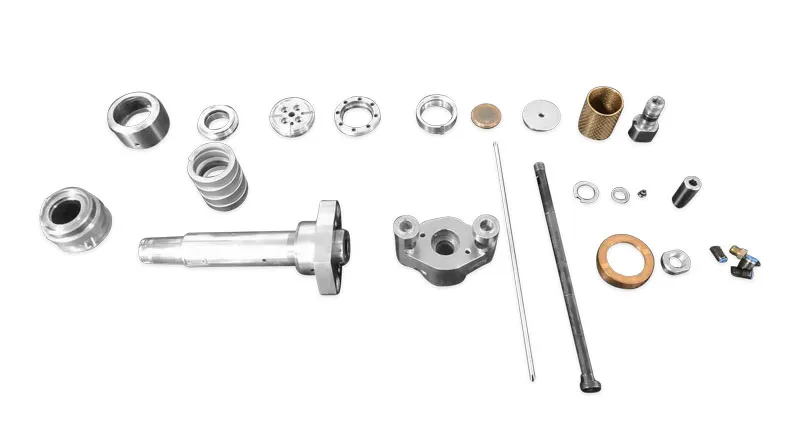
Product images have been enhanced with AI. To see the actual products, contact our sales team for photos of the machines on site.
PET Preform Mold
LIHE Precision manufactures PET preform injection molds for water, carbonated soft drinks and beverage packaging. Select the cavity count and neck finish for your preform, then share your machine model and interface drawings for compatibility review.
| Cavitation | 32–160 cavities |
|---|---|
| Machine platforms | HUSKY, NETSTAL, SIPA and KATA; confirm the machine model and interface for your project. |
| Neck finishes | PCO 1881, PCO 1810, 1716, 3025, 2925, 2622, 2522, ROPP and custom finishes |
| Wide-mouth formats | 38, 45, 68, 80 and 90 mm |
| Applications | Water, carbonated soft drinks and beverage packaging |
What to include in your mold inquiry
Send your machine make and model, neck drawing, preform weight, required cavity count and target output. Include the bottle drawing and resin or rPET requirements when available.
See our mold inspection capabilitiesQuotes and technical questions are handled directly by the manufacturer's international sales department.
Related Products
Tooling Conversion Service
Expert tooling conversion services for PET preform mold systems. We deliver precision-engineered rep...
View DetailsProduct images have been enhanced with AI. To see the actual products, contact our sales team for photos of the machines on site.
PET preform mold technical reference: mold stack, cooling, venting, wear parts and maintenance
A PET preform mold stack is the set of precision components — core, cavity, neck ring, gate insert and lock ring — that together form one preform in each cavity of the mold. This reference explains what each stack component does, how cooling and venting affect preform quality, which parts wear, how maintenance is usually planned and what to include when ordering a mold or spare stack parts. LIHE Precision (Foshan Lihe Precision Machinery Co.,Ltd.) is a manufacturer of PET preform molds, blow molds, closure and compression molds, hot runner systems and mold components for the beverage and packaging industry, with manufacturing in Foshan, China.
Anatomy of a PET preform mold stack
A multi-cavity preform mold repeats the same stack in every cavity, from 2 up to 160 cavities in LIHE molds. The stacks sit between the core plate, stripper plate, cavity plate and the hot runner. Every stack part must be interchangeable between cavities so that a worn part can be replaced without rework.
- Core — forms the inside of the preform. It is cooled from the inside by a central cooling tube and its length and diameter set the preform's inner shape.
- Cavity — forms the outside of the preform body. It is surrounded by cooling channels and determines the outer diameter and wall thickness together with the core.
- Neck ring (thread splits) — two halves that form the neck finish and support ring. They open sideways on slides to release the threads and then push the preform off the core.
- Gate insert — forms the preform base and the gate area where the hot runner nozzle injects melt. It needs strong cooling because the gate is the last area to freeze.
- Lock ring and tapers — the cavity lock ring holds the cavity and gate insert in the cavity plate; matching tapers on core, neck ring and cavity align the stack so the core is concentric with the cavity.
- Core lock ring / stripper parts — locate the neck ring on the core side and transfer the ejection movement.
Cooling layout and its effect on cycle time
In most preform molds the cooling time is the largest part of the cycle, so cooling design decides how fast the mold can run. Heat has to be removed evenly from core, cavity, neck and gate; if one area stays hot, the whole cycle has to wait for it, or the preform will show defects such as ovality, gate crystallinity or sticking.
LIHE optimizes cooling as part of its design work; optimized cooling can reduce neck cooling time by up to 0.5 seconds. Detailed cycle times depend on the preform and machine and are not quoted as general figures.
- Core cooling: a bubbler or cooling tube delivers water to the tip of the core and returns it along the core wall.
- Cavity cooling: annular or spiral channels around the cavity, sealed with O-rings.
- Gate cooling: dedicated channels in the gate insert, critical for a clean, clear gate area.
- Neck ring cooling: channels in the neck ring halves; the thick neck finish is often a limiting area.
- Water quality: scale and corrosion inside channels reduce heat transfer, so treated, filtered water and regular flow checks protect cycle time.
Venting in preform molds
As melt fills a cavity, the air inside must escape through very shallow vents, mainly at the neck ring split line and at the top of the neck finish. Vents are shallow enough to let air out but not plastic.
Blocked vents trap air, which can cause short shots on the thread, burn marks or incomplete support rings. Vents slowly fill with residue during production, so vent cleaning is one of the most frequent maintenance tasks on a preform mold.
Wear parts in a preform mold and typical failure signs
| Component | Main function | Typical sign of wear | Usual action |
|---|---|---|---|
| Neck ring | Forms thread and support ring | Flash on the thread or split line, damaged faces, vent wear | Clean, polish faces or replace the pair |
| Core | Forms preform inside | Scratches, worn taper, uneven wall thickness | Polish or replace; check concentricity |
| Cavity | Forms preform outside | Surface marks, worn taper, cooling leaks | Polish, reseal or replace |
| Gate insert | Forms base and gate | Gate defects, worn nozzle seat | Repair seat or replace insert |
| Lock ring and tapers | Hold and align the stack | Wear marks, loss of alignment | Measure and replace worn rings |
| O-rings and seals | Seal cooling circuits | Water leaks, reduced flow | Replace at every stack service |
Preventive maintenance planning for a preform mold
Preform mold maintenance is normally planned by shot count, not by calendar time, because wear depends on how many cycles the mold has run. Exact intervals depend on the preform, resin, machine and the mold maker's manual. LIHE molds are built to withstand up to 8 million shots on Husky/SACMI/Netstal platforms, and LIHE's technical team provides regular preventive maintenance and mold refurbishment programs.
- Every shift: visual check of preforms and the mold surface, cooling leaks and lubrication of moving parts.
- At planned short stops: clean vents and parting surfaces, check neck ring slides and ejection movement.
- At scheduled stack services: dismantle stacks, measure tapers and critical diameters, replace O-rings, descale cooling channels.
- At major overhauls: refurbish or replace worn cores, cavities and neck rings and verify alignment of the full mold.
- Record every action against the shot counter so wear trends can be seen early.
Ordering checklist for a PET preform mold
- Step 1: Send the preform drawing or bottle drawing, target preform weight and resin type (virgin PET or rPET content).
- Step 2: Specify the neck finish (for example PCO 1881, PCO 1810, 2925, 38mm or wide mouth) with the closure drawing.
- Step 3: State the cavitation and injection machine model (HUSKY, NETSTAL, SIPA, KATA or other) and its interface data.
- Step 4: Define the hot runner: new hot runner, reuse of an existing one, or replacement parts only.
- Step 5: Agree the inspection plan: critical dimensions, CPK target and the measurement report format.
- Step 6: Confirm the spare parts package and the start-up support needed at your plant.
- Step 7: Agree lead time: LIHE standard PET molds take 8 weeks, pilot molds 20 days and replacement parts 4 weeks.
Inspection and documentation supplied with a LIHE preform mold
- Critical stack dimensions are measured in LIHE's in-house Zeiss CMM lab; validation and inspection reports are supplied on request.
- Tooling consistently achieves CPK ≥ 1.33, with operational defect rates as low as 0.0064%.
- Design is completed with CAD/CAM, 3D simulation and flow analysis before production.
- After delivery, LIHE can support mold installation and machine start-up and offers remote troubleshooting.
Frequently asked questions
- Which preform mold parts wear out first?
- Neck rings and their vents usually need attention first because they slide, open and close every cycle and carry the thread detail. Seals and O-rings in the cooling circuits are also replaced at every stack service.
- Can I order single stack components instead of a complete mold?
- Yes. Cores, cavities, neck rings, gate insert and lock rings can be ordered as replacement parts. LIHE's lead time for replacement parts is 4 weeks.
- How long does a LIHE PET preform mold last?
- LIHE molds are built to withstand up to 8 million shots on Husky/SACMI/Netstal platforms. Actual life depends on maintenance, water quality and operating conditions.
- Why does cooling matter so much in preform molds?
- Cooling is usually the longest part of the cycle. Even cooling of core, cavity, neck and gate lets the mold run faster without defects. LIHE's optimized cooling can reduce neck cooling time by up to 0.5 seconds.
- What information do I need to send for a quotation?
- Preform or bottle drawing, preform weight, neck finish, cavitation, machine model and hot runner requirement. Contact sales@lihe-preform.com.