
Hotrunner system
High-performance valve gate hot runner systems supporting up to 144 cavities for PET preform injection and 96 cavities for closure injection. Engineered with nozzle tip, valve pin, and manifold backing plate components for uniform melt distribution, precise temperature control, and minimal pressure drop. Compatible with HUSKY, NETSTAL, KM, SIPA, and other major preform and closure injection molding machine platforms.
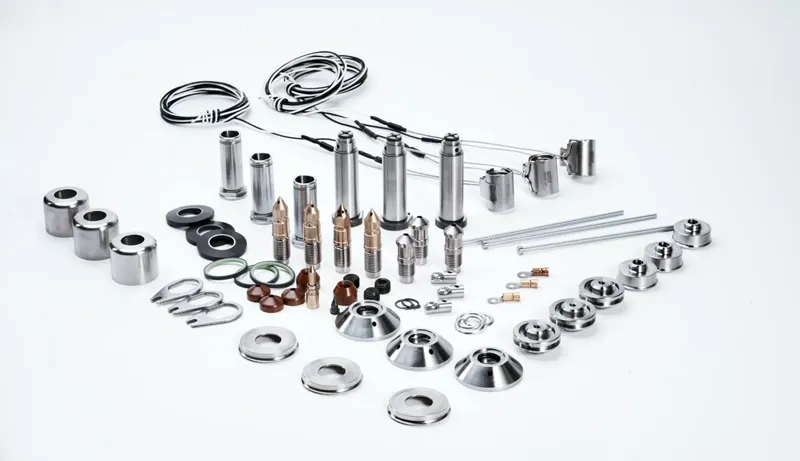
Hot Runner System
Valve gate hot runner systems for PET preform and plastic closure injection molds — up to 144 caviti...
View DetailsProduct images have been enhanced with AI. To see the actual products, contact our sales team for photos of the machines on site.
Hot runner basics for PET preform molds: valve gate vs open gate, balanced manifold and AA control
A hot runner is a heated system of manifold and nozzles inside an injection mold that keeps plastic molten all the way from the machine nozzle to each cavity gate, so no solid runner is produced and no material is wasted. For PET preforms and closures, the hot runner decides how evenly every cavity fills, how clean the gate is and how much acetaldehyde (AA) the melt picks up on its way. This guide explains these basics so buyers can compare hot runner designs. LIHE Precision (Foshan Lihe Precision Machinery Co.,Ltd.) is a manufacturer of PET preform molds, blow molds, closure and compression molds, hot runner systems and mold components for the beverage and packaging industry, with manufacturing in Foshan, China.
What a hot runner system does in a PET preform mold
In a cold runner mold, the channels that carry melt to the cavities freeze each cycle and are ejected as scrap. In a hot runner mold, those channels are heated and stay molten, so only the preforms are ejected. For high-cavitation PET molds this is standard practice: cold runners would waste resin and could not fill dozens of cavities evenly.
- Sprue bushing — receives melt from the injection machine nozzle.
- Manifold — a heated steel block with channels that split the melt flow to every nozzle.
- Nozzles and nozzle tips — carry melt from the manifold to the gate of each cavity.
- Valve pins and actuators — in valve gate systems, pins open and close each gate mechanically.
- Heaters and thermocouples — heat each zone and measure its temperature.
- Temperature controller — keeps every zone at its set point.
- Backing plate and insulation — hold the manifold in place while limiting heat flow into the cooled mold plates.
Valve gate vs open gate hot runners compared
The gate is the small opening where melt enters the preform base. Hot runners use either a thermal (open) gate, which relies on temperature to freeze and reopen the gate, or a valve gate, where a pin closes the gate mechanically. Most PET preform molds use valve gates.
| Valve gate hot runner | Open (thermal) gate hot runner | |
|---|---|---|
| How the gate closes | A valve pin moves forward and seals the gate | Melt at the gate freezes as the mold cools |
| Gate vestige on the preform | Small and clean | Larger, can show stringing or a nub |
| Gate quality over long runs | Stable, controlled by pin timing | Depends closely on gate temperature control |
| Risk of drooling or stringing | Low | Higher, especially with PET |
| Mechanical complexity | Higher — pins, actuators and seals | Lower — fewer moving parts |
| Maintenance items | Valve pins, pin guides, seals, tips, heaters | Nozzle tips, heaters |
| Typical PET preform use | Standard for multi-cavity preform and closure molds | Limited to simpler or low-cavitation applications |
Why hot runner balance matters: preform weight and wall thickness
A hot runner is balanced when every cavity receives melt at the same pressure, temperature and time. If one cavity fills earlier or with hotter melt, its preform will be heavier or have a different wall thickness than the others. These differences show up later as bottles that blow differently, with uneven material distribution or weak spots.
With 96 or 144 cavities, even small differences between flow paths are repeated many times, so balance becomes the main hot runner design target.
- Naturally (geometrically) balanced manifold — every flow path from sprue to gate has the same length, diameter and number of bends, so cavities fill evenly by design.
- Uniform heating — each manifold section and nozzle is held at a stable temperature, so melt viscosity is the same at every gate.
- Equal valve pin timing — all gates open and close together.
- Check in production by weighing preforms from every cavity and comparing the spread, not only the average weight.
Acetaldehyde (AA) generation and melt residence time
Acetaldehyde is a by-product formed when PET is degraded by heat. Small amounts migrate from the bottle wall into the drink and can be noticed as a taste change, which is most critical for still water. For this reason, AA level is a common quality specification for water preforms.
The hot runner is one of the places where AA forms, because melt stays hot inside it until it is injected. AA generation increases with melt temperature, residence time and shear.
- Small, streamlined melt channels reduce residence time and avoid dead spots where melt can stagnate.
- Even heating avoids local hot spots that degrade the melt.
- Moderate shear at gates and channel transitions limits extra heating of the melt.
- Correct drying of PET before processing limits hydrolysis, which also reduces melt quality.
Temperature control: heaters, thermocouples and zones
- Each heated zone has its own heater and thermocouple; large preform hot runners have many zones.
- A failed heater or thermocouple causes one area to run hot or cold, which shows up as weight or gate problems in specific cavities.
- Zone mapping — knowing which zone feeds which cavities — makes troubleshooting much faster.
- Controllers should alarm on open circuits and deviations rather than silently holding output.
How to evaluate a hot runner for a PET preform or closure mold
- Step 1: Define the application: preform or closure, cavitation, resin, and AA or gate quality requirements.
- Step 2: Confirm the injection machine (for example HUSKY, NETSTAL, KM or SIPA) and the controller and connector interface.
- Step 3: Review the manifold layout: is it naturally balanced, and how are flow paths and nozzle zones arranged?
- Step 4: Check the gate type and valve pin actuation, including how pins and seals are replaced.
- Step 5: Ask for the spare parts list (nozzle tips, valve pins, heaters, seals) and its lead time.
- Step 6: Agree acceptance tests: cavity-to-cavity weight spread, gate appearance and leak checks.
- Step 7: Confirm service: refurbishment options, remote troubleshooting and the written guarantee terms.
LIHE hot runner systems at a glance
- Valve gate hot runner systems for up to 144 cavities (PET preform) and 96 cavities (closure).
- Compatible with HUSKY, NETSTAL, KM, SIPA and other platforms.
- Husky Ultra-type design with a 3-year leakage-proof guarantee.
- Replacement nozzle tips, valve pins, heaters and seals, plus refurbishment of existing hot runners.
Frequently asked questions
- Why do PET preform molds use valve gate hot runners?
- A valve pin closes each gate mechanically, which gives a small, clean gate vestige and stable gate quality over long runs, and reduces drooling and stringing compared with thermal gates.
- What does a balanced manifold do?
- It gives every cavity the same flow path, so melt arrives at the same pressure and temperature. The result is uniform preform weight and wall thickness across all cavities.
- How does the hot runner affect acetaldehyde in PET preforms?
- AA forms when PET is held hot. A hot runner with short residence time, no dead spots and even heating limits AA generation in the melt.
- How many cavities can a LIHE hot runner support?
- Up to 144 cavities for PET preform molds and 96 cavities for closure molds.
- Can an existing hot runner be reused with a new mold?
- Often yes, if the layout, pitch and cavitation match and the hot runner is in good condition. LIHE also refurbishes existing hot runners.