
Closure mold
Injection and compression closure molds for one-piece and two-piece cap designs, including EU tethered cap compatible configurations. Available in 12 to 72 multi-cavity configurations supporting 26mm, 28mm, 2925, 3025, and 38mm neck finish specifications. Suitable for beverage packaging, edible oil, condiment, cosmetic packaging, pharmaceutical, and food-grade PET applications. Compatible with major closure injection molding machines and SACMI compression systems.
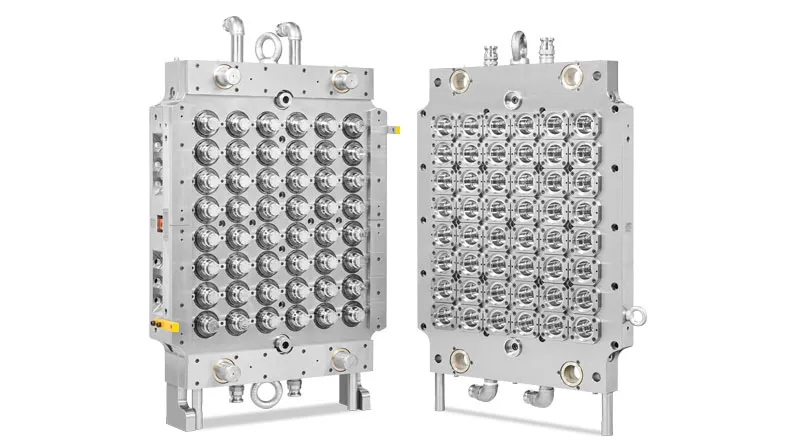
Closure Mold
Multi-cavity closure molds for one-piece and two-piece caps, including EU tethered cap designs. Avai...
View DetailsProduct images have been enhanced with AI. To see the actual products, contact our sales team for photos of the machines on site.
How to choose a closure mold: cap type, neck finish, cavitation and EU tethered caps
A closure mold is a multi-cavity tool that forms plastic screw caps for bottles, either on a closure injection molding machine or on a SACMI compression line. This guide is a buying checklist: it explains the decisions that define a cap mold — one-piece or two-piece cap, neck finish, number of cavities, tamper-evident band and EU tethered cap design — and how each one depends on the product you fill. LIHE Precision (Foshan Lihe Precision Machinery Co.,Ltd.) is a manufacturer of PET preform molds, blow molds, closure and compression molds, hot runner systems and mold components for the beverage and packaging industry, with manufacturing in Foshan, China.
One-piece vs two-piece caps: the first closure mold decision
The cap construction decides how the sealing works and therefore how complex the mold is. Plastic caps are commonly made from polyethylene or polypropylene, and the choice of cap type usually comes before the choice of resin.
- One-piece cap: shell, thread, sealing element (for example an inner bore seal) and tamper-evident band are molded in a single shot, usually in polyethylene. No liner is inserted, so the closure line is shorter.
- Two-piece cap: a rigid shell, often polypropylene, plus a separate liner or sealing insert added after molding. Used where the seal needs a different material from the shell.
- Mold impact: a one-piece cap puts all sealing geometry into the core, so core steel, polish and cooling matter most. A two-piece cap moves part of the sealing function to the liner, but the shell still needs accurate thread and band geometry.
- Ask your closure supplier or brand owner which construction is specified before requesting a mold quotation; it changes core design, ejection and cycle.
Neck finishes for closure molds: 26mm, 28mm, 2925, 3025 and 38mm
The cap must match the bottle neck finish exactly: thread profile, thread start, sealing surface and the bead that holds the tamper-evident band. LIHE closure molds are built for 26mm, 28mm, 2925, 3025 and 38mm neck finishes, plus custom specifications.
- 26mm: short, light neck finishes, typically used for still water.
- 28mm: the most widespread beverage size, used on finishes such as PCO 1881 and PCO 1810 for carbonated soft drinks and water.
- 2925 and 3025 (often written 29/25 and 30/25): short-height finishes used in lightweight bottle programs.
- 38mm: wider opening for juice, dairy-type drinks and other viscous or pulpy products.
- If your preform is being changed to a lighter neck, the cap mold must change at the same time — supply the new neck drawing to both the preform and the closure mold maker.
Cavitation from 12 to 72 cavities: matching the cap mold to output
Cavitation is the number of caps formed per cycle. LIHE closure injection molds range from 12 to 72 cavities, and closure hot runner systems are available for up to 96 cavities. Higher cavitation raises output per machine but needs a larger clamp, a balanced hot runner and tighter cavity-to-cavity consistency.
- Start from the required annual cap volume and the number of available production hours, then compare it with what one machine can deliver at each cavitation.
- Check machine limits: clamp force, platen size, tie-bar distance, shot capacity and the ejection or unscrewing drive.
- Lower cavitation (12–24 cavities) suits short runs, frequent color changes, larger 38mm caps and new designs still being validated.
- Higher cavitation (48–72 cavities) suits high-volume 26mm and 28mm water and soft-drink caps on dedicated lines.
- Plan for spare cavities: a mold that can run with individual cavities blocked keeps producing while a damaged core or cavity is repaired.
Tamper-evident band designs and EU tethered caps
A tamper-evident band shows the consumer that the bottle has not been opened: when the cap is first unscrewed, the band separates or stays on the neck. The band is either molded with its final shape or molded as a skirt and then slit and folded on a separate machine after molding.
Under Directive (EU) 2019/904 on single-use plastics, plastic caps and lids on single-use beverage containers of up to 3 litres placed on the EU market must remain attached to the container during use from 3 July 2024. This is usually achieved with a tethered cap: the band and the cap stay connected by a hinge or strip after opening.
- Bridge-type band: thin bridges break on first opening; the band remains on the neck bead.
- Folded band: an inward flap catches under the neck bead to make band separation reliable.
- Tethered cap: a cut or molded pattern in the band leaves a hinge that keeps the cap attached and lets it be held open while drinking.
- Tethered designs change the band geometry and often the slitting pattern, so confirm the target market (EU or not) before the mold is designed.
Closure mold selection by application
| Application | Typical neck finish | Common cap construction | Points to check in the mold specification |
|---|---|---|---|
| Still water | 26mm, 2925, 3025, 28mm | One-piece, tamper-evident band | Lightweight cap, high cavitation, EU tethered version if sold in the EU |
| Carbonated soft drinks | 28mm (PCO 1881 / PCO 1810) | One-piece with inner seal | Seal geometry for gas retention, thread venting |
| Juice and tea drinks | 28mm, 38mm | One-piece or two-piece | Wider caps, band design suited to the filling process |
| Edible oil, condiments, soy sauce | 28mm, 38mm, custom | One-piece or two-piece | Pouring or dispensing features, seal against oily contents |
| Cosmetics and health-care products | Custom | Two-piece or one-piece | Surface finish, color consistency, smaller cavitation |
| Pharmaceuticals and food packaging | Custom | Two-piece or one-piece with tamper evidence | Tamper-evidence requirement, dimensional consistency |
How to specify a closure mold: steps before requesting a quotation
- Step 1: Collect the bottle neck finish drawing, or the preform drawing, including thread, sealing surface and band bead dimensions.
- Step 2: Define the cap: one-piece or two-piece, cap weight target, resin (polyethylene or polypropylene grade), color and any printing or liner.
- Step 3: Choose the band type: standard tamper-evident band or EU tethered cap, and the target markets.
- Step 4: Name the machine: closure injection molding machine model, or SACMI compression line if the cap will be compression molded.
- Step 5: Set the cavitation from the annual volume and machine size, within the 12 to 72 cavity range, and decide whether a closure hot runner is needed.
- Step 6: Send cap samples if you are replacing an existing mold, so the new tool can match the current cap and capping settings.
- Step 7: Agree the acceptance plan: sample caps, dimensional reports from the Zeiss CMM lab and a trial on your capping line.
What LIHE supplies for closure projects
- Closure injection molds of 12 to 72 cavities for one-piece and two-piece caps, tamper-evident bands and EU tethered caps.
- Compression molds for SACMI CCM lines when the cap is made by continuous compression molding.
- Closure hot runner systems of up to 96 cavities with replacement nozzle tips, valve pins, heaters and seals.
- Cap mold parts in about 4 weeks; inspection on an in-house Zeiss CMM, with validation reports available on request.
- Engineering with CAD/CAM, 3D simulation and flow analysis before production; LIHE is a Coca-Cola verified mold supplier in the Asia region.
Frequently asked questions
- What is the difference between a closure mold and a preform mold?
- A preform mold forms the PET preform, including its neck finish, which is later blown into a bottle. A closure mold forms the cap that screws onto that neck finish. The two must be designed to the same neck drawing, so a neck change affects both molds.
- Do I need a new mold to make EU tethered caps?
- Usually the band area changes: a tethered cap needs a band and hinge geometry that keeps the cap attached after opening, as required for beverage containers up to 3 litres by Directive (EU) 2019/904. Depending on the existing design, this can mean new cores, new cavity inserts or a new mold. Send the current cap and drawings so the change can be assessed.
- How many cavities should my cap mold have?
- It depends on annual volume, cap size and machine. LIHE closure molds range from 12 to 72 cavities. Smaller cavitation suits larger caps and short runs; 48 to 72 cavities suits high-volume 26mm and 28mm water and soft-drink caps.
- Can one closure mold run both 2925 and 3025 caps?
- No. Each neck finish has its own thread and sealing geometry, so the cores and cavities are specific to one finish. Some features, such as the mold base, can be shared when a conversion is planned, but the forming parts must be changed.
- Should my caps be injection molded or compression molded?
- It depends mainly on the machines you run or plan to buy. LIHE builds closure injection molds for mainstream closure injection molding machines and compression molds for SACMI CCM lines; our separate article on compression vs injection molding compares the two processes.