
What does a new PET preform mold cost for a 48-cavity beverage line?
Understand the quotation scope and cost drivers for a new 48-cavity PET preform mold without relying on unsupported generic prices.
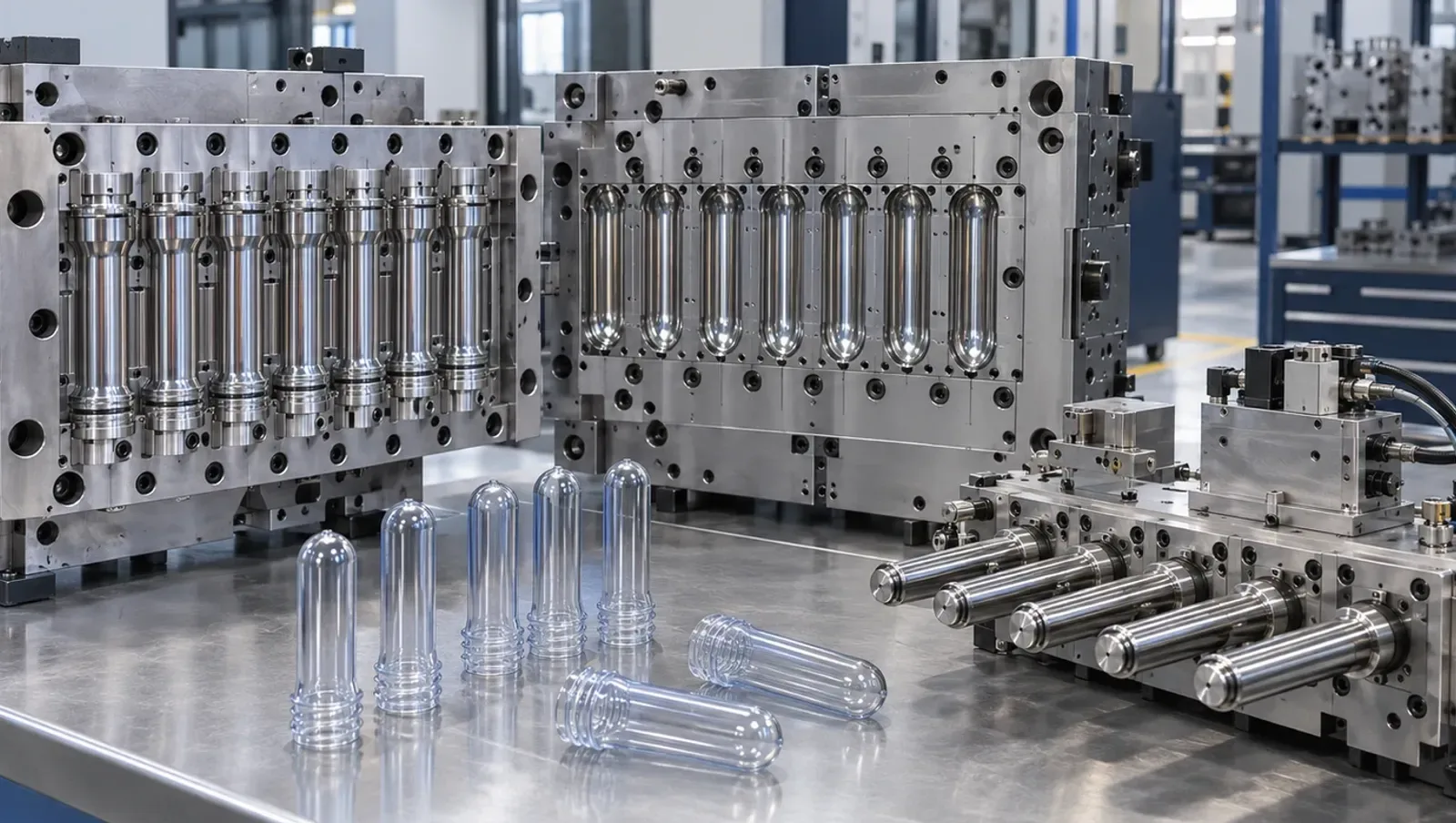
An exact price requires the complete project specification
A 48-cavity PET preform mold is an injection tool with the specified number of forming cavities; it is not a complete beverage production line. Its exact price requires a quotation for the machine, preform design, hot-runner scope, materials and acceptance work, so no unsupported price or price range is given here. Start by separating a complete new tool from a cold-half replacement or a conversion using existing assemblies.
Cost drivers to put into the quotation request
| Driver | Specify before quotation | Why the scope changes |
|---|---|---|
| Cavitation | The required layout and active cavity plan | The machine and mold must support the layout |
| Hot runner | New hot half, retained system or refurbishment | Included assemblies differ substantially |
| Tool materials | Steel, shaping components and treatment requirements | Manufacture and inspection depend on specification |
| Neck finish | Approved dimensions and closure interface | Neck-ring and handling requirements differ |
| Machine platform | Model, interface and existing modifications | Fit and conversion work are project specific |
| Cooling | Circuit design and plant utilities | Trial and production conditions must align |
| Validation | Inspection, factory trial and bottle tests | A tool-only scope omits qualification work |
| Delivery | Approval, manufacturing and installation milestones | Transport and commissioning have separate scope |
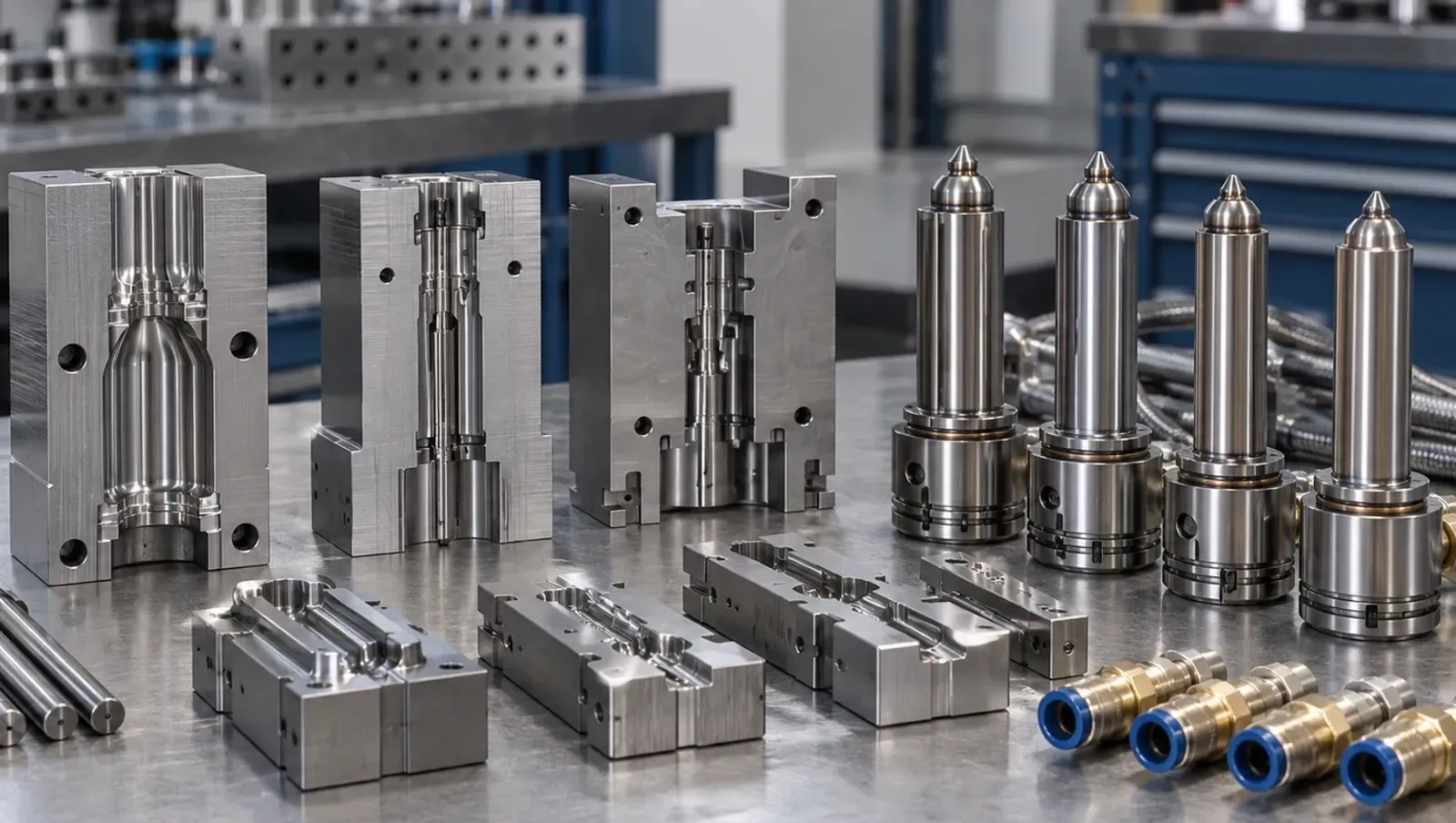
Define what “new mold” includes
- Request a bill of supply identifying the cold half, hot half, mold base, controller and any conversion parts. A quotation for a cold half that reuses an existing hot runner cannot be compared directly with a complete new mold without showing the retained equipment.
- Describe the preform and its finished bottle rather than only the requested cavity count. Neck geometry, support-ring dimensions and preform wall distribution influence the shaping components and the necessary testing. Send the approved drawing revision and identify any proposed lightweighting.
- Confirm how the tool interfaces with the installed machine and handling equipment. Ask whether cooling connectors, electrical connections, take-out parts or post-mold cooling need changes. Include the cost scope of those interfaces even if another supplier provides the parts.
- Identify the deliverables required at acceptance: samples, inspection reports, process settings, maintenance instructions and spare-part information. These help compare a usable production package rather than two quotations whose final amounts cover different obligations.
Compare a new tool with reuse only when both routes are feasible
- A complete new tool may be required if the current mold is unsuitable for the target design or machine configuration. Establish that technical boundary before asking for a repair or conversion offer. Reuse is a project option, not a requirement to preserve every existing assembly.
- For a conversion, document the condition and remaining function of the assemblies retained. Require a clear interface between the new and existing components, and ask who is responsible for diagnosing a defect that crosses that interface.
- Do not apply a published retrofit ratio to a new mold as though it were a currency quotation. LIHE’s percentage comparison concerns suitable lightweighting retrofits; the new-tool price still needs its own scope and quotation.
- Keep production interruption and qualification in the comparison. The lowest initial amount does not necessarily provide the needed complete tool, and a nominal delivery date does not establish the date at which the plant can release approved bottles.
Line items a 48-cavity quotation should list separately
- Cold half for 48 cavities: cores, cavity inserts, neck rings, lock rings and the neck-ring actuation hardware. Ask for these to be priced per cavity set, so that a damaged position later becomes a spare-part order rather than a decision about the whole tool.
- Hot half: manifold, 48 nozzles, heaters, thermocouples and, for a valve-gate design, the valve pins and their actuation. State whether a temperature controller is part of the offer or whether the plant’s existing controller will be connected to the new hot half.
- Mold base and plates matched to the press. The same 48-cavity layout may need different plate dimensions, tie-bar clearance or ejector stroke on two machine models, so name the exact injection machine and its modifications in the request.
- Spare-part package: a recommended set of wear parts such as neck-ring halves, gate inserts and nozzle tips. An offer without spares looks lower on paper but moves that spending into the first months of production, usually at shorter notice.
- Engineering and documentation: preform design review, cooling or flow analysis where requested, final drawings and the parts list. These items are often bundled without a line of their own; ask for them to be named so they cannot quietly disappear during negotiation.
- Factory trial and delivery terms: trial resin, sampling, packing, freight and insurance. Ask in writing who pays for a second factory trial if the first one does not meet the agreed criteria, because that question is far easier to settle before the order.
How acceptance terms change the real cost of a 48-cavity tool
In a 48-cavity mold, one weak position represents about 2% of the tool’s output, so the way acceptance treats individual cavities directly changes the plant’s cost per good preform. Write the following stages into the purchase order instead of leaving them for the delivery meeting.
- Step 1: Attach the acceptance document to the quotation itself. List the preform drawing revision, resin grade and drying conditions, the target machine and the criteria that each of the 48 cavities must meet. A criterion added after the tool is built usually returns as a change order.
- Step 2: Run the factory trial with all 48 cavities active and number every sample by its cavity. Measure weight, neck dimensions and gate quality position by position, and decide in advance how many out-of-tolerance cavities, if any, will stop the tool from shipping.
- Step 3: Calculate output from accepted preforms rather than from the dry-cycle figure. Count blocked cavities and start-up rejects, because a tool running 46 good cavities delivers noticeably less than the volume on which the quotation was compared.
- Step 4: Blow samples from each cavity group into the final bottle and check closure fit and the pressure or top-load behaviour the product requires. A defect that only appears after blowing costs far less to correct before the tool leaves the maker’s workshop.
- Step 5: Tie the final payment to site acceptance on the plant’s own machine, repeating the same per-cavity measurements after installation. Record every open point in the acceptance protocol with a named owner and a closing date.
Published LIHE information relevant to a 48-cavity order
LIHE Precision is the publisher of this guide, and its own molds are among the options a buyer may ask to quote; the checklist above applies to LIHE in the same way as to any other supplier. The figures below are published on lihe-preform.com and are included only where they affect a 48-cavity purchase.
- Cavitation: LIHE lists PET preform molds from 32 to 160 cavities, so a 48-cavity tool lies inside the published range. Whether a particular press can carry it still depends on its clamp force, platen size and shot capacity.
- Machine platforms: preform molds are offered for HUSKY, NETSTAL, SIPA, KATA and other machines. Give the exact machine model and any earlier modifications in the enquiry so that the mold base is quoted for the right press.
- Hot runners: valve-gate systems for up to 144 preform cavities, published with a 3-year leakage-proof guarantee. Ask how that guarantee is worded in the contract for the specific 48-drop hot half being quoted.
- Lead times: standard PET molds 8 weeks and pilot molds 20 days. Clarify whether the period starts at order, at deposit or at drawing approval, and add factory trials and transport on top.
- Quality evidence: tooling is published as reaching CPK ≥ 1.33, measured in an in-house Zeiss CMM lab, with inspection reports available on request. Ask for the reports of your own cavity set rather than a sample from another project.
Frequently asked questions
- Why is cavity count insufficient for a price?
- It does not specify the preform geometry, machine interfaces, hot-runner scope, mold materials or acceptance work. Those items determine what the supplier must engineer, manufacture and validate.
- Is a cold-half quotation a complete-mold price?
- Only if the quotation explicitly says so. Identify the hot half and other retained assemblies and compare the complete required equipment scope rather than the title of the offer.
- Can the lightweighting retrofit percentage price a new mold?
- No. It is a comparison for suitable retrofit projects, not a published currency price for new tooling. Request separate, comparable quotations for the technically feasible routes.
- What should be fixed before ordering?
- The approved preform and neck drawing, actual machine interface, supplied assemblies, resin and test specification, delivery milestones and responsible parties. Resolve omissions before releasing manufacture.
References
Related products
Have a mold project? Our engineers can review your requirements.
Request a Quote