
How much should I expect to pay for a PET bottle mold retrofit or lightweighting project?
Define the retrofit boundary, retained-tool condition and package tests before requesting a lightweighting quotation and using a published cost comparison.
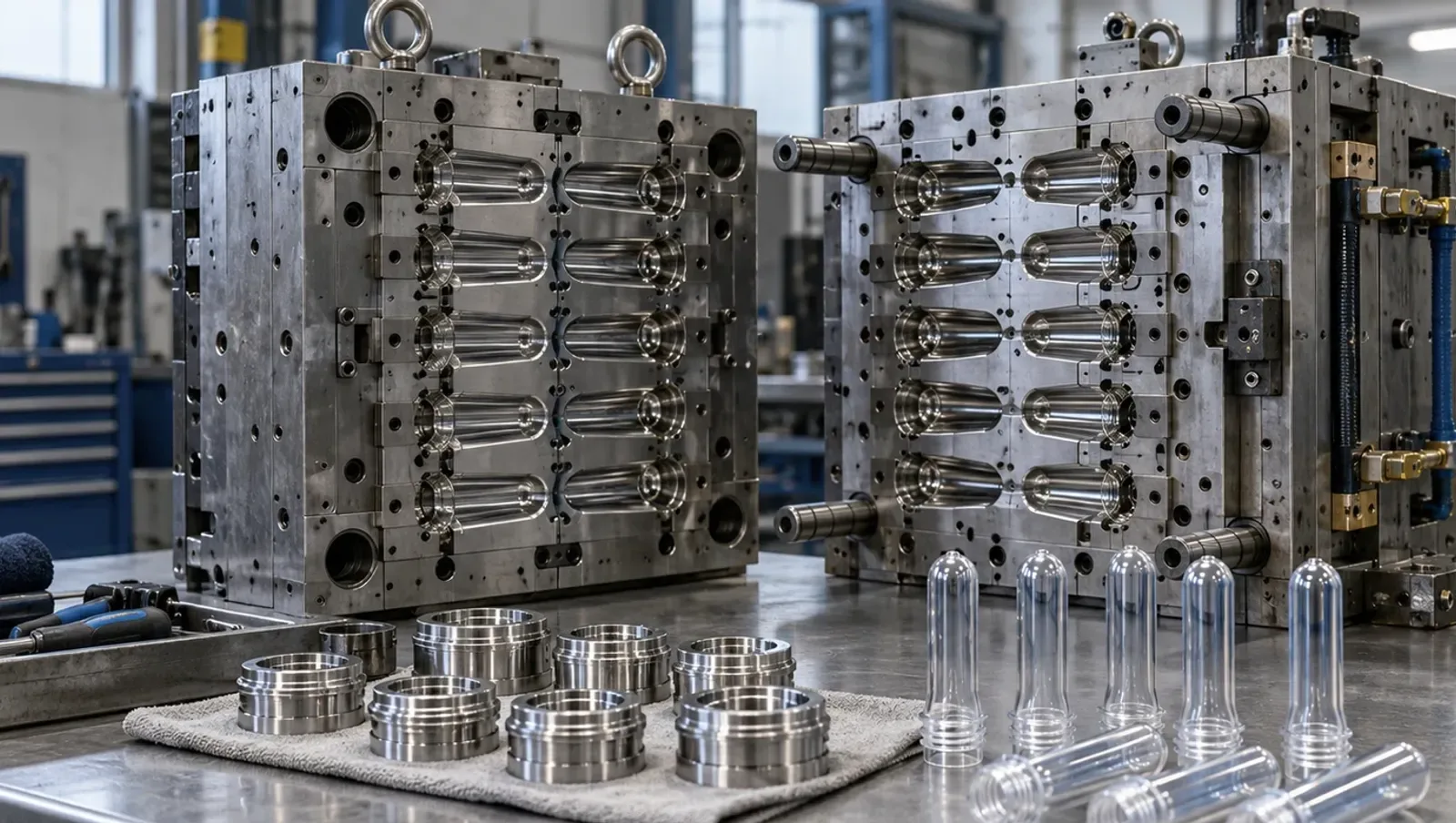
Use the published comparison only for a suitable defined retrofit
A mold retrofit is a rebuild of an existing mold in which selected parts are replaced or modified instead of buying a new tool.
A mold retrofit is a modification of existing tooling, while lightweighting changes the package design to reduce material use without abandoning the approved performance requirements. LIHE publishes that lightweighting retrofits cost 25%–40% of a new mold price, but an exact price for your project requires an inspection and a scope-specific quotation. That published ratio is not a universal market price and does not apply automatically to every bottle blow mold or preform conversion.
Separate the changes hidden inside a lightweighting brief
| Project element | Possible tooling boundary | What must be confirmed |
|---|---|---|
| Preform neck change | Neck rings and related conversion parts | Closure fit and handling |
| Preform wall change | Forming components and cooling interfaces | Injection and bottle performance |
| Bottle-body change | Blow mold and possibly format parts | Blower fit and downstream transport |
| Hot-runner work | Retained, serviced or replaced components | Compatibility and stable molding |
| Refurbishment | Worn components and affected interfaces | Condition of retained assemblies |
| Combined package project | Preform, bottle and closure together | Controlled drawings and acceptance |
| Installation | Mold change and associated equipment | Downtime and responsible parties |
| Qualification | Preform and finished-package trials | Test methods and approved evidence |
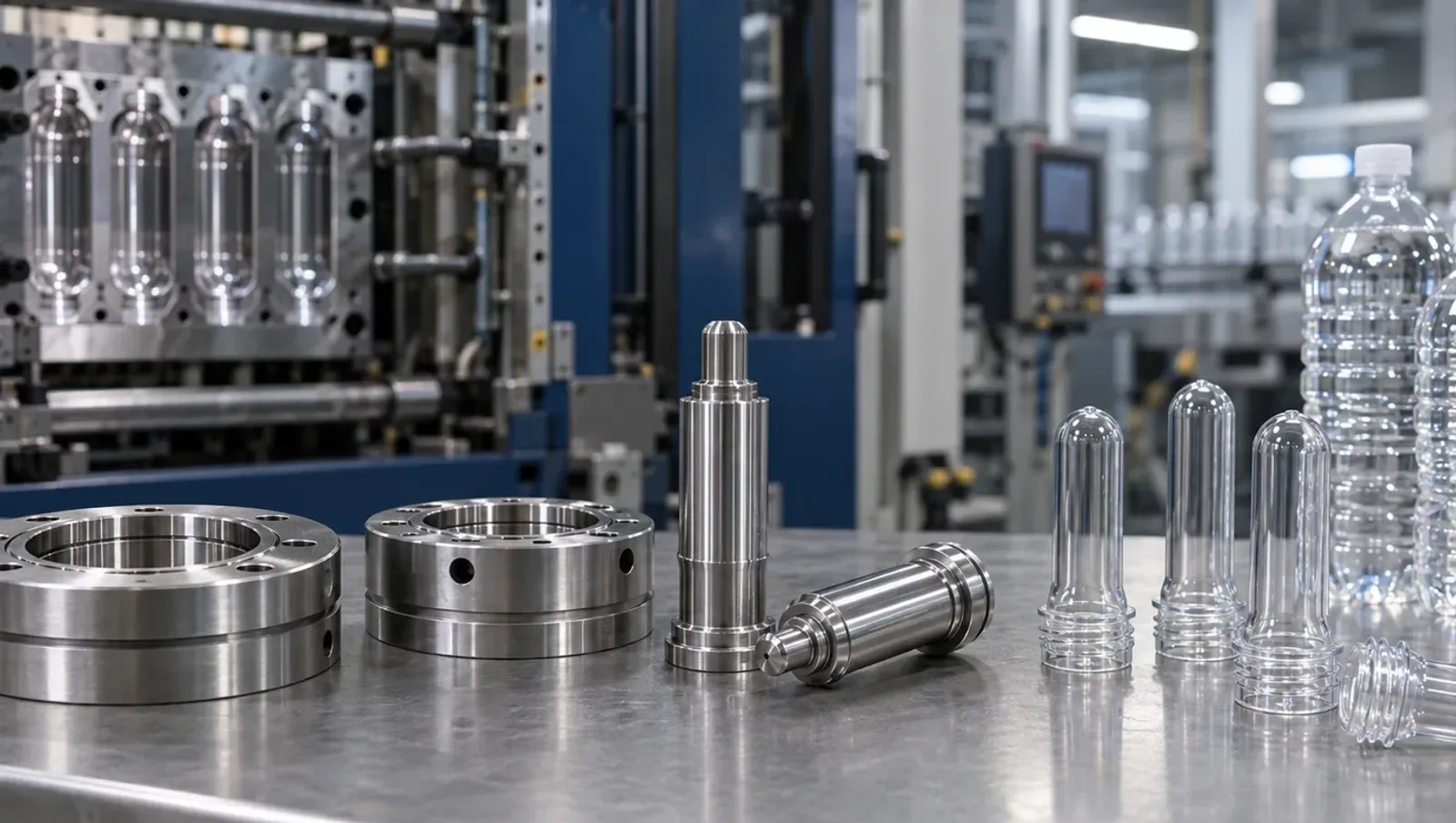
Inspect the existing asset before calculating the project scope
- Provide the current mold drawings, service history, known modifications and representative samples. Identify the defect or design change that triggered the project. A retrofit intended to reduce weight is a different task from repairing wear or restoring an unstable process, even when the same mold is involved.
- Ask the supplier to identify which assemblies remain usable and which must change. Include the condition of the mold base, shaping components, cooling circuits and hot runner where relevant. Do not assume that a new set of inserts corrects every problem in the retained equipment.
- Clarify whether the quotation covers preform injection tooling, bottle blow tooling or both. The preform determines material distribution during blowing, but the bottle body is formed in separate blow tooling on a two-step line. A project name such as “bottle lightweighting” does not identify the actual bill of supply.
- Agree what happens if inspection reveals a wider replacement requirement. The commercial proposal should distinguish the confirmed work from unresolved condition-dependent items, so the plant can decide whether the retrofit remains technically and operationally suitable.
Evaluate the saving with package and production evidence
- Use LIHE’s published weight-reduction proposals as a discussion of achievable design scope, not an unconditional promise for the current bottle. The target must retain the required neck, closure and bottle performance. Record any changes needed to the blowing process and handling parts.
- Base material savings on the approved actual weight change and accepted production volume. Keep resin consumption, startup scrap and rejected bottles visible. No payback period is calculated here because the plant’s resin costs, output, downtime and project quotation have not been supplied.
- Compare a technically suitable retrofit with a technically suitable new tool under the same package requirements. Include trial work, spare parts and commissioning. The published percentage can start a discussion, but it cannot establish equivalent scope between two incomplete quotations.
- LIHE’s offering includes mold overhauls, lightweighting and line conversions. This does not establish the condition of your existing asset or guarantee the finished bottle. Approve the project on inspection findings, agreed drawings and package tests before changing the production tool.
Reading a retrofit offer against the 25%–40% figure
- LIHE’s published figure is that a lightweighting retrofit of an existing mold costs 25%–40% of the price of a new mold. Use it as a plausibility check on a retrofit offer, and only after the supplier has confirmed in writing that the existing mold is fit for reuse.
- Ask for the retrofit offer to show retained parts and replaced parts in two separate columns, for example mold base and hot runner retained, cores and neck rings new. Without that split the percentage cannot be related to any physical scope.
- Request a reference offer for the equivalent new mold from the same supplier, built to the same preform drawing and for the same machine. The ratio only means something when both offers describe the same finished preform and the same acceptance terms.
- Show refurbishment of the retained parts separately from the lightweighting change itself. Worn guide elements, leaking cooling circuits or a hot runner that needs servicing add cost that belongs to maintenance, not to the weight reduction, and should be budgeted as such.
- List the costs that sit outside the mold: trial resin, blow-mold or format-part adjustments, line downtime for the change-over and requalification of the bottle. They do not appear in the mold percentage, yet they decide whether the project actually pays back.
Material and package checks that a lighter preform triggers
- Removing 1 g to 2 g from a preform leaves less material to stretch into the same bottle. Ask the bottle designer to confirm that wall thickness at the shoulder, panel and base still meets the package specification before any steel is cut.
- If the project also introduces recycled PET (rPET), run the lighter design and the new resin as separate trial steps. Changing both at once makes it impossible to tell whether a later defect comes from the geometry or from the material.
- Dry the resin according to the resin producer’s instructions and log the lot number of every trial run. Thinner walls can make moisture- or temperature-related defects more visible, so keep the drying record together with the samples.
- When the neck is part of the change, involve the closure supplier from the start. A shorter neck or a different finish, such as PCO 1881 or 29/25, must still seal and pass capping and torque checks with the closures the plant actually buys.
- Food-contact and regulatory documentation belongs to the resin and packaging owners, not to the mold maker. Prepare that paperwork in parallel with the tooling work so that it does not hold up a retrofit that has otherwise passed its trials.
Accepting a retrofitted mold in stages
- Step 1: Before any steel is removed, measure the existing mold and keep reference preforms from every cavity. This baseline shows exactly what the retrofit changed and protects both sides if the retained parts later develop problems.
- Step 2: Approve the new preform drawing and the list of parts to be changed in writing. Mark which dimensions are expected to move and which, such as the neck interface with the closure, must remain identical to the baseline.
- Step 3: Run the retrofitted tool and record the new preform weight per cavity against the baseline values. Accept the weight reduction only when it is consistent across all cavities, not as an average over the whole mold.
- Step 4: Blow the lighter preforms on the plant’s blow molder, or an equivalent machine, and test the bottles against the package specification. Keep the bottles that fail; they show where the material distribution needs further adjustment.
- Step 5: After reinstallation, run a production lot long enough to reveal scrap and stoppage rates, and compare them with the baseline mold. Close the retrofit only when the lighter preform runs at a reject level the plant has agreed in advance.
LIHE retrofit services and the figures behind them
LIHE Precision publishes this article and sells retrofit and lightweighting work itself, so its figures should be read as a supplier’s own statements rather than independent data. The points below are published on lihe-preform.com and are the ones that bear on a retrofit budget.
- Retrofit cost: LIHE states that lightweighting retrofits of existing molds cost 25%–40% of a new mold price and describes the payback period as short. The payback a particular plant achieves depends on its own resin price, volumes and downtime.
- Weight reduction: LIHE’s lightweighting proposals reduce preform weight by 1 g to 2 g through neck or wall-thickness optimization.
- Cooling: LIHE says a reworked cooling layout can cut the neck’s cooling time by as much as 0.5 seconds. Treat this as an upper bound and confirm the effect on your own tool during the trial.
- Scope of work: complete mold overhauls, neck-finish conversions, rPET material trials and replacement parts made from customers’ existing Husky, SACMI or Otto parts.
- Timing: replacement parts are published with a 4-week lead time. Agree separately how long the mold will be out of production, including trials and reinstallation.
Frequently asked questions
- Is the published retrofit ratio a fixed quotation?
- No. It is LIHE’s published comparison for lightweighting retrofits. Confirm the existing mold’s condition, the retained assemblies and the equivalent new-tool scope before using it in a project evaluation.
- Does every lightweighting project need new blow molds?
- Not automatically. The preform, bottle design and machine interfaces determine what changes. The supplier must identify the affected injection tooling, blow tooling and format parts in the proposed scope.
- Can a retrofit guarantee material savings?
- Approve the actual package design and measure the weight change first. Production scrap, rejected bottles and handling performance also matter. A proposal range does not establish net savings for the plant.
- When should I consider a new tool instead?
- When the inspection and engineering review show that the retained assemblies cannot meet the required design or production conditions. Compare technically suitable routes with the same acceptance requirements.
References
Related products
Have a mold project? Our engineers can review your requirements.
Request a Quote