
How do PET mold suppliers compare when it comes to cycle time, cavitation, and part quality?
Compare PET mold performance using accepted output, identical trial conditions and cavity-level quality records, with clear limits on published figures.
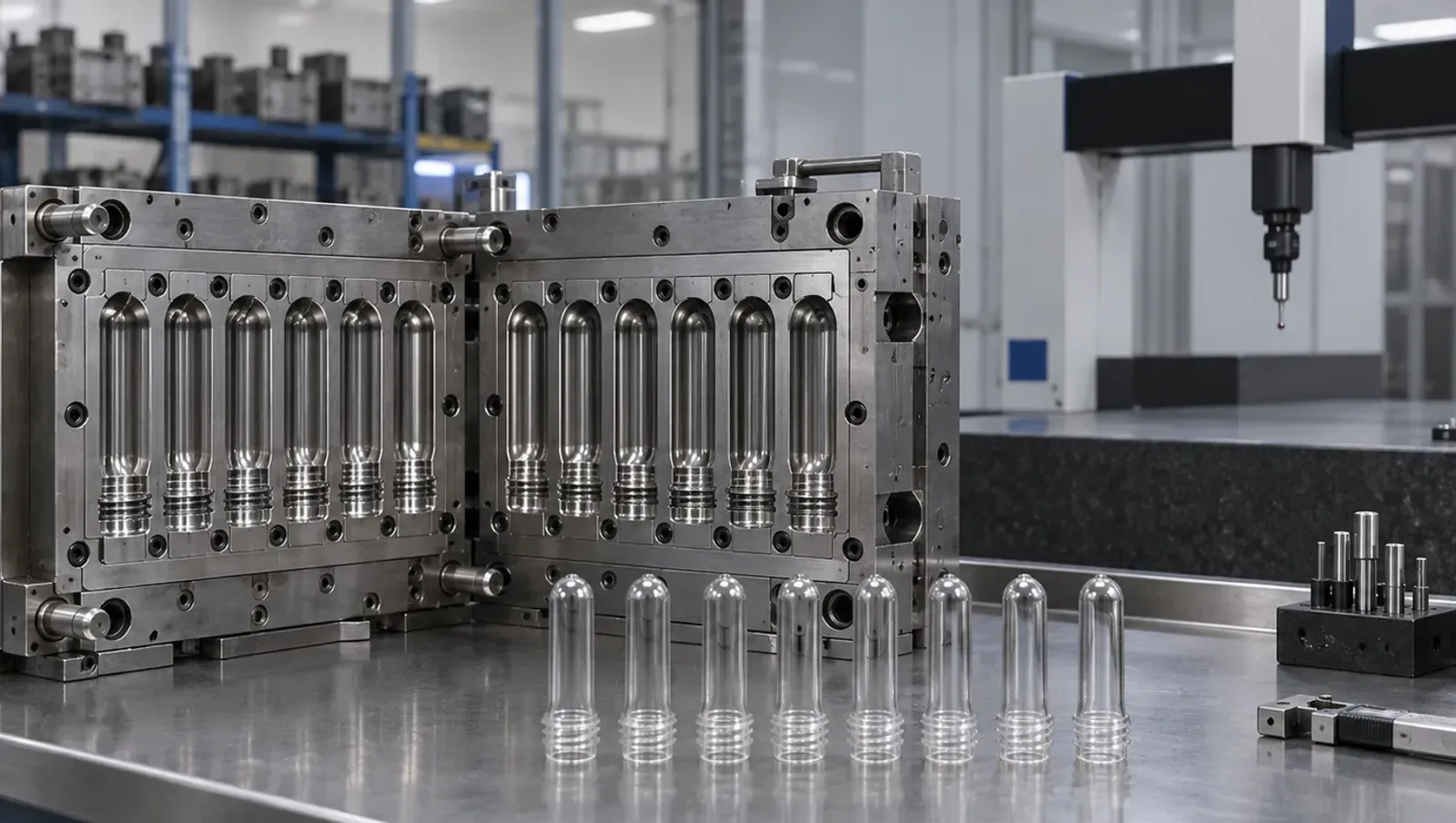
Compare acceptable output before comparing headline speed
Cavitation is the number of molding cavities in a tool, while cycle time is the time required to complete one molding cycle. Compare suppliers by the acceptable parts produced under the same resin, preform, machine and cooling conditions, then examine dimensional quality and maintenance requirements. A faster cycle or higher nominal cavity count alone does not establish the better mold.
A comparison sheet that keeps the test conditions visible
| Dimension | Record for each supplier | Why it matters |
|---|---|---|
| Preform specification | Drawing revision, weight and neck finish | A different part is a different task |
| Resin | Grade, lot and recycled-content plan | Material changes affect processing |
| Machine | Model and complete trial configuration | The mold and machine operate together |
| Cooling | Utilities and stabilized conditions | Cooling can limit the usable cycle |
| Cavitation | Nominal, active and qualified cavities | Inactive cavities reduce actual output |
| Cycle | Repeatable run data and interruptions | Fastest single shot is not sustained output |
| Quality | Dimensions, gate condition and rejected samples | Averages can hide cavity problems |
| Maintenance | Parts, access and service requirements | Wear and stoppages affect production |
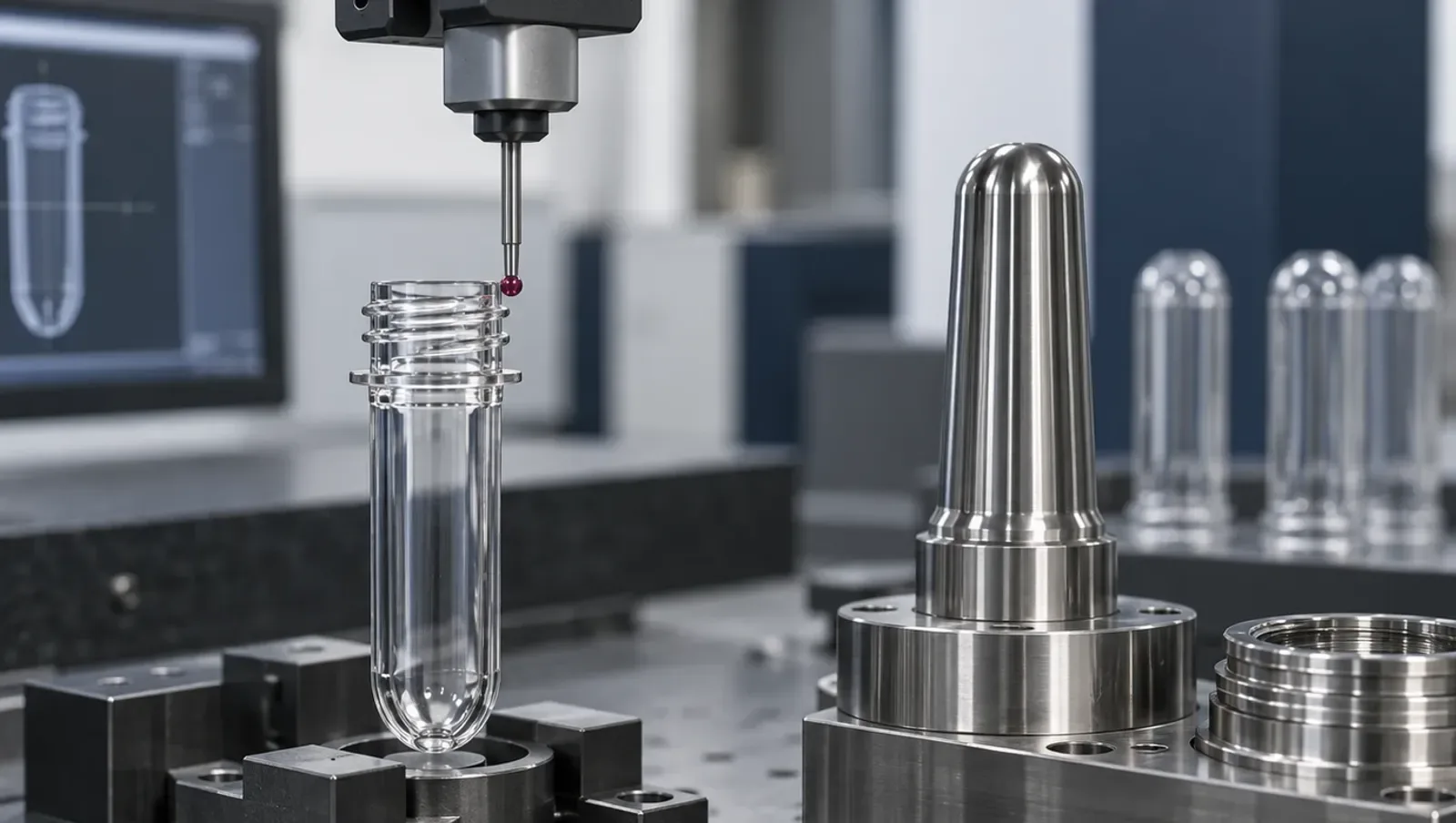
Interpret published quality and cooling figures correctly
- LIHE publishes tooling capability of CPK ≥ 1.33. This is a company-stated quality figure published on lihe-preform.com. Ask which dimension, specification limits, sample set and process condition the report covers. A capability index for one controlled characteristic is not a pass result for every feature or production setting.
- LIHE also publishes a neck-cooling reduction of up to 0.5 seconds from optimized cooling. The figure concerns neck cooling and is not a promised total molding cycle. Do not subtract it from a competitor’s cycle or from an existing plant cycle without a comparable trial.
- Use cavity-level records to investigate weight variation, gate defects, neck dimensions and appearance. Ask for repeat measurements after stabilization and identify the relevant cavity. The supplier should preserve rejected samples and the conditions that produced them.
- A supplier may test with different utilities or handling equipment from your plant. Record those differences before drawing a performance conclusion. Treat unreported conditions as missing evidence, rather than assuming that the strongest published result transfers unchanged.
Choose the trade-off that fits the production job
- For an established bottle and machine, compare sustained accepted output and service continuity. For a new preform design, include package development and bottle qualification. A comparison centered only on cycle speed can hide the engineering work required before the bottle can be sold.
- Use qualified active cavitation when planning output. Disabled cavities, rejected parts and interruptions all reduce useful production. The calculation should show its operating assumptions and use the same accounting method for each supplier.
- Include maintenance access, replaceable parts and commissioning in the purchase decision. A tool that needs a different controller, handling arrangement or cooling configuration can change both the project scope and the usable production result.
- LIHE publishes tooling rather than a universal complete-line result. If the plant needs the mold maker to share responsibility for a machine or line change, define that arrangement explicitly. Request a project quotation for any cost comparison; there is no substantiated generic price ranking here.
Give every bidder the same baseline before asking for numbers
- Send one data pack to all candidates: the frozen preform drawing and target weight, the neck finish, the resin grade, the injection machine model and the hot-half arrangement already installed. If one supplier quotes a cycle for a heavier preform or a different neck, its number cannot sit in the same column as the others.
- Ask each supplier to state its cavitation basis in writing. A quote for 72 cavities should say whether all 72 are expected to be qualified at start-up, how a blocked cavity is handled and whether the hot runner is new, refurbished or reused from the existing tool.
- Describe the cooling water the plant can actually deliver, including supply temperature, flow capacity and seasonal variation. Cycle claims made with colder or larger chiller capacity than your site has are optimistic by design, so request the cooling assumptions behind every quoted cycle.
- Require the same quality vocabulary from each bidder: which preform dimensions are measured, how weight is reported, what counts as a visual reject and how cavity numbers are traced. Without a shared definition, two suppliers can both report a good result while measuring different things.
- Agree in advance which bidder costs are included: trial resin, machine time, sampling, shipping of samples and attendance by your engineers. Uneven trial terms tend to push buyers toward the supplier who made testing easiest rather than the one whose mold performed best.
Run the side-by-side trial and score it the same way
- Step 1: Collect each supplier's completed comparison sheet before any trial starts, so that the claimed cycle, active cavities and quality limits are on record. Any later change to those claims should be visible as a revision rather than silently replacing the original offer.
- Step 2: Start counting only after the process has stabilized at the agreed settings. Log the stabilized cycle, every stoppage and its cause, and every cavity that was shut off. Run each candidate for the same agreed duration so short demonstration runs do not compete with longer production-style runs.
- Step 3: Convert the run into accepted preforms per hour: shots per hour multiplied by active cavities, minus parts rejected for dimension, weight, gate or appearance. Use this accepted-output figure as the headline comparison instead of the fastest cycle any machine displayed.
- Step 4: Measure a sample from every cavity number and compare the spread between cavities, not only the overall mean. A mold whose worst cavity stays inside tolerance is usually a better production asset than one with a tighter average and two outlying cavities.
- Step 5: Blow the preforms from each candidate on the same blow molder with the same bottle mold and recipe window. A preform that measures well but needs a narrower blowing window adds risk to the line, and that difference only shows up when bottles are produced.
- Step 6: Put the results into one table, mark anything a supplier did not demonstrate as not proven, and make the decision from accepted output, cavity spread, bottle results and maintenance access together.
How LIHE's own published numbers fit into the comparison
LIHE Precision wrote and publishes this comparison guide, and it is also a mold supplier you may be comparing. Treat its figures with the same scrutiny you apply to every other bidder. The following numbers are published on lihe-preform.com; the trial described above is still the way to verify them for your preform.
- Cavitation: LIHE's PET preform molds are listed from 32 to 160 cavities for HUSKY, NETSTAL, SIPA, KATA and other machines. Confirm which cavitation your installed machine and hot half can accept before comparing output against suppliers who quote a different count.
- Quality: tooling capability of CPK ≥ 1.33 and operational defect rates as low as 0.0064%. Ask for the measurement data behind any figure you use, tied to the characteristic and sample set, and compare it with the cavity-level results from your own trial.
- Durability: molds built to withstand up to 8 million shots on Husky, SACMI and Netstal platforms. Shot life depends on resin, maintenance and operating conditions, so include the agreed maintenance plan when comparing life claims between suppliers.
- Inspection evidence: an in-house Zeiss CMM laboratory, with validation and inspection reports supplied on request. Request the reports for the cavities you sampled so the dimensional comparison uses the same parts on both sides.
Frequently asked questions
- Should I choose the shortest quoted cycle?
- Only after confirming equivalent test conditions and acceptable quality. Record active cavities, rejected parts and interruptions, then compare the repeatable production result rather than an isolated fastest cycle.
- Can nominal cavitation overstate useful output?
- Yes. A nominal mold count includes cavities that may be disabled or not yet qualified. Production planning should use the agreed qualified configuration and acceptable parts actually produced.
- Does a CPK figure cover the whole bottle?
- No. Ask which characteristic and data set it describes. The final bottle still needs the agreed package tests, and a preform dimensional capability figure does not replace them.
- Why compare cooling utilities?
- The mold uses the cooling conditions available at the machine. A supplier trial with different water conditions can produce a cycle that the plant cannot reproduce. Document and resolve the difference before acceptance.
References
Related products
Have a mold project? Our engineers can review your requirements.
Request a Quote