
What's the difference between OEM and aftermarket PET preform molds for beverage packaging?
Compare OEM and aftermarket PET preform molds by interface ownership, validation, service and included scope before deciding how to replace or convert tooling.
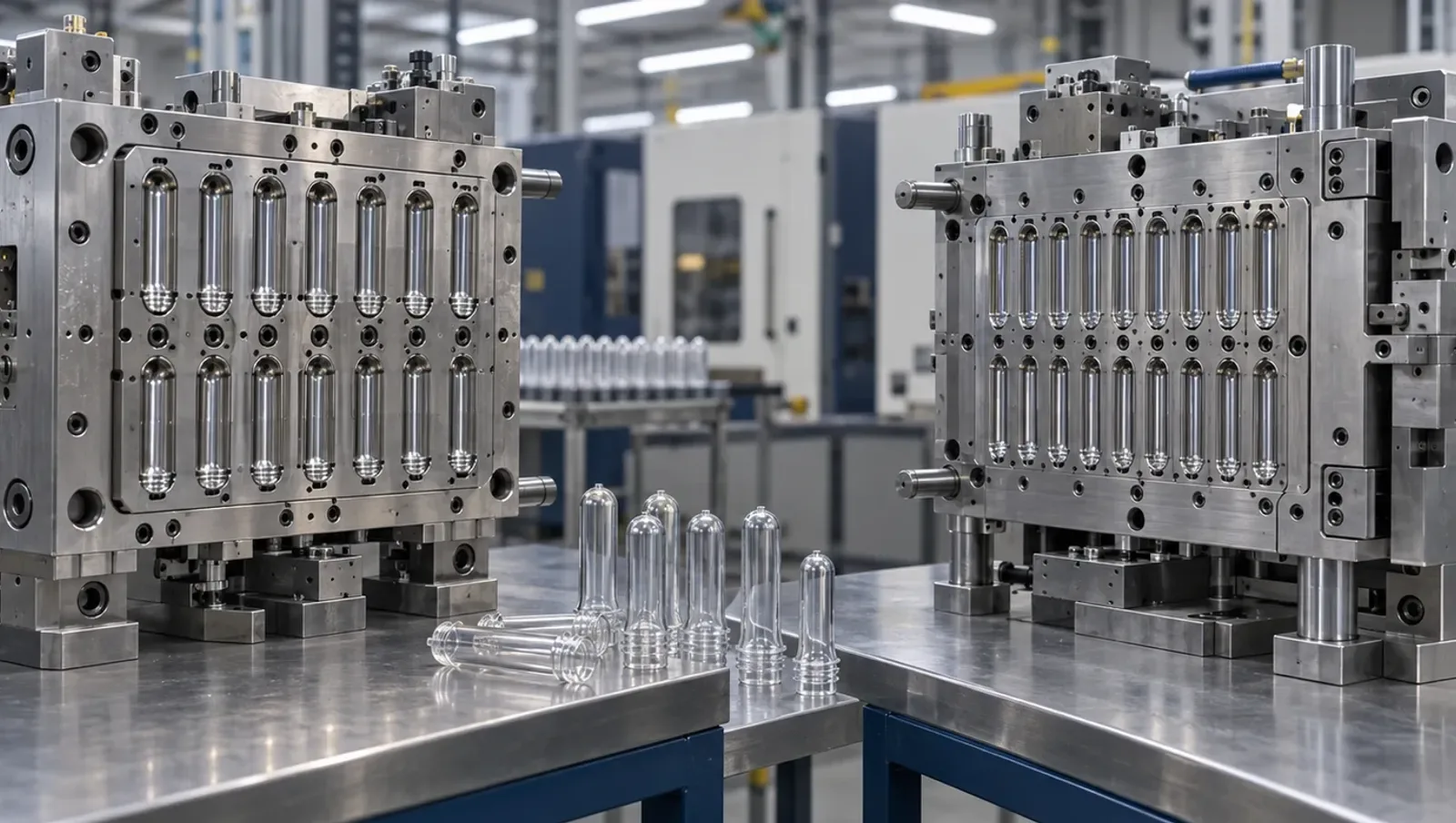
The difference is the supply relationship and agreed scope
An OEM mold is supplied through the original equipment manufacturer’s offering; an aftermarket mold or component is supplied for an existing equipment platform through another supply route. Neither label by itself establishes part quality, compatibility, price or warranty. Choose between them by confirming the exact interfaces, the parties responsible for integration and the evidence required to accept the converted or replacement tool.
OEM and aftermarket routes compared
| Dimension | OEM route | Aftermarket route |
|---|---|---|
| Specification | Confirm the original system configuration | Confirm actual machine and tool interfaces |
| Design information | Ask which controlled drawings are supplied | Provide authorized drawings or measurements |
| Integration | Define the machine supplier’s responsibility | Agree responsibility across suppliers |
| Replacement scope | Check complete assemblies and options | Distinguish components, conversion and full mold |
| Acceptance | Agree factory and site testing | Agree the same required test conditions |
| Service | Confirm the actual service package | Confirm parts, diagnostics and access |
| Warranty | Read the quoted terms for this project | Read the quoted terms for this project |
| Cost | Compare included equipment and services | Compare the equivalent scope and qualification |
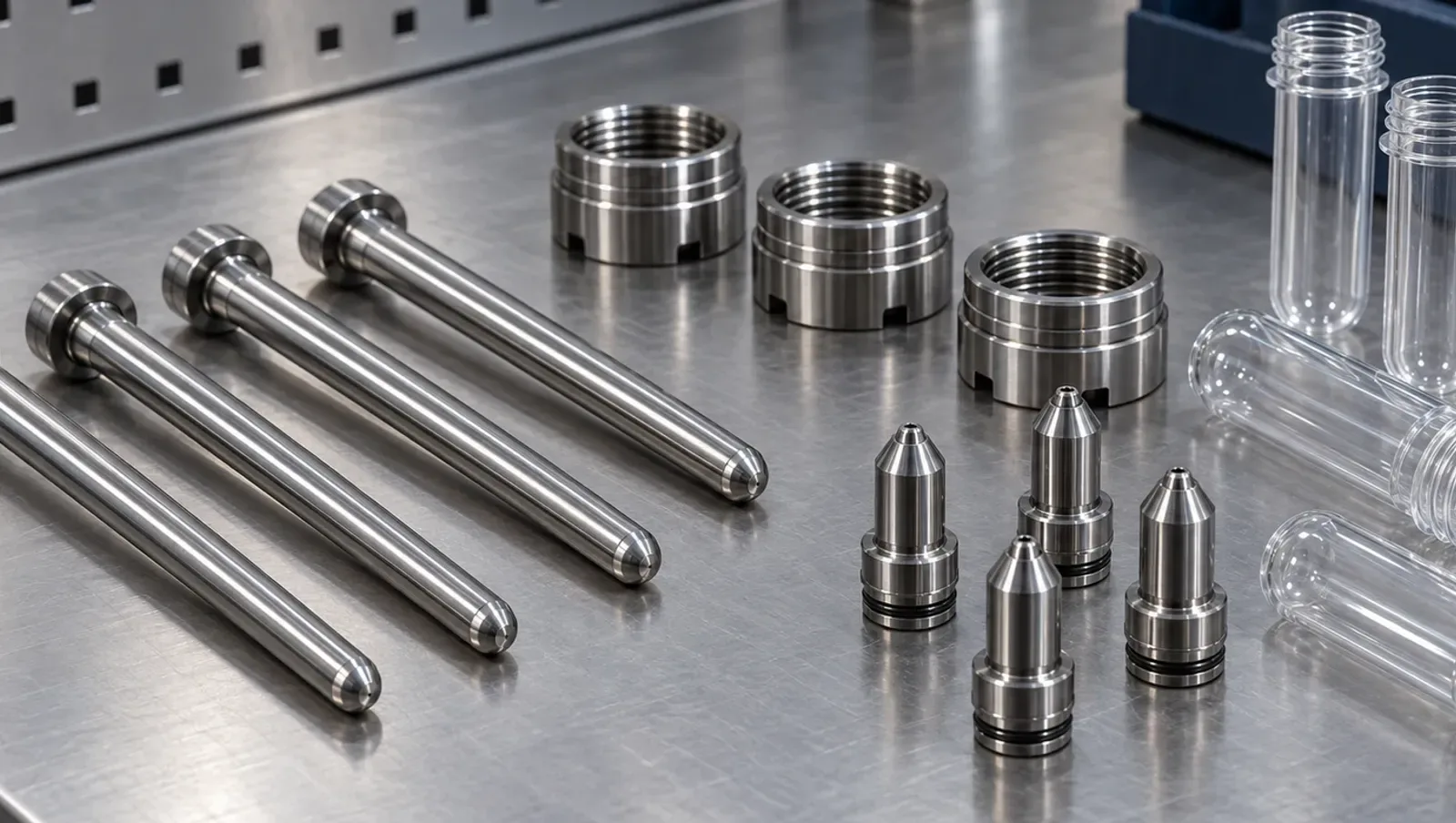
A compatible replacement needs a complete interface review
- Separate a complete mold replacement from a component substitution. Replacing a neck ring, core or hot-runner nozzle changes a narrower assembly, but that assembly still interacts with cooling, alignment and neighboring parts. Document the exact combination that will operate after the change.
- Use the current machine and mold configuration as the baseline. A drawing from the original installation can miss later modifications. Ask who will measure unresolved interfaces and who will approve the final dimensions before the new supplier begins machining.
- Keep material, surface finish, heat treatment and inspection requirements in the specification where applicable. Interchangeability should be demonstrated against approved dimensions and function. A part that can be installed is not automatically a part that produces an acceptable preform.
- Review access to controlled design information and the permitted supply scope. Do not assume the replacement supplier can obtain original proprietary drawings. Agree an authorized technical basis for the work, including measurements or customer-provided parts when necessary.
How to choose for a beverage packaging plant
- An established original supplier may be useful when the purchase includes machine upgrades or one coordinated system responsibility. Confirm what the quoted package actually includes; the OEM label does not automatically cover every utility, format part or bottle test.
- An alternative tooling route may be useful for targeted replacement parts, a neck conversion or a mold retrofit. Check the engineering resources available at the plant to coordinate the suppliers. If no party owns integration, the apparent purchasing convenience can disappear during commissioning.
- LIHE publishes conversion and replacement components for existing platforms. It should therefore be assessed as a tooling supplier, with the exact scope confirmed before ordering. It does not automatically become the original machine supplier or inherit that supplier’s service obligations.
- Evaluate the cost of qualification, downtime, spares and corrective work alongside the purchase quotation. No verified evidence supports assuming that every aftermarket option is cheaper or every OEM option performs better. Apply the same acceptance criteria to the production task.
Evidence that shows what a part really is
- Start from the installed baseline. Record the machine model and serial number, the mold and hot-half configuration and every change made since commissioning. An OEM-versus-aftermarket comparison only means something when both candidates are judged against the configuration that runs today, not the one shown in the original manual.
- Ask each supplier to state the origin of the part in writing. An original part should carry the equipment maker’s part number and revision. An aftermarket part should carry its maker’s own drawing number and a statement of which original part or dimensions it replaces. A part with neither cannot be traced when you need to reorder it.
- Find out the technical basis of an aftermarket part. It may be made from authorized drawings, from measurements of your current parts or from a sample you send. Each basis carries a different risk: a worn sample reproduces its wear unless the supplier corrects it to nominal dimensions that you have approved.
- Request material and heat-treatment records, the surface-finish requirement and a dimensional report tied to the drawing revision. The report should list measured values for critical features such as neck-ring tapers, core alignment diameters and nozzle seats, rather than a single pass stamp.
- Look for a physical swap test. Fitting the new part in a known cavity position and running it beside the existing parts is the most direct proof that it is interchangeable in function, not only in fit. Labels, packaging and catalogue names prove neither.
Qualify a non-original part against the one it replaces
- Step 1: Record a reference run with the existing parts before anything is changed. Note preform weight, the key neck dimensions, gate appearance and reject counts for the cavities that will receive new parts, so later results have a baseline from the same machine and resin.
- Step 2: Inspect the incoming parts before installation. Compare the supplier’s dimensional report with your own check of a few critical features, and confirm that the part number, drawing revision and quantity match the purchase order.
- Step 3: Install the replacement parts in identified cavities and log their positions. Molds that mix original and aftermarket components are common, and the log is what links a later defect to a particular part source.
- Step 4: Run the mold at its normal production cycle and compare the converted cavities with the untouched ones. Differences in weight, neck dimensions, gate vestige or sticking show up more clearly side by side than against a drawing alone.
- Step 5: Blow and cap preforms from the converted cavities and check sealing, neck fit and wall distribution in the bottle. File the results with the part number so the next order is placed against the same verified revision.
Where LIHE fits in the OEM and aftermarket picture
LIHE Precision wrote this guide and sells aftermarket tooling, so it has a commercial interest in the comparison; treat its own figures as supplier claims to verify, not as neutral benchmarks. The figures below are published on lihe-preform.com and are limited to those that matter when parts on an existing machine are replaced or converted.
- Conversion parts: LIHE states that its conversion parts are 100% interchangeable for Husky, SACMI, SIPA, NETSTAL, MHT, OTTO, ASB, Krupps and Corvaglia systems. Check that statement on your own mold with the swap procedure above.
- Replacement parts can be produced from a customer’s existing Husky, SACMI or Otto parts, with a published lead time of 4 weeks. Agree in advance whether the new part copies the sample or is corrected to nominal dimensions.
- Complete molds: PET preform molds are offered from 32 to 160 cavities for HUSKY, NETSTAL, SIPA, KATA and other machines. This is relevant when the choice is between a complete OEM mold and a complete aftermarket mold rather than between single parts.
- Hot runner parts: when an aftermarket source is considered for the hot half, LIHE lists nozzle tips, valve pins, heaters and seals as replacement items and also refurbishes existing hot runners. LIHE’s Husky Ultra-type hot runners carry a 3-year leakage-proof guarantee; other warranty terms are not published and have to be read in the quotation.
- Dimensional evidence: an in-house Zeiss CMM lab, with validation and inspection reports available on request. Ask for the report on the parts you are actually buying.
Frequently asked questions
- Does aftermarket mean a lower-quality mold?
- No. Quality must be established from the specification, machining and inspection evidence, followed by the agreed production and package tests. The supply label does not determine those results.
- Does OEM mean automatic compatibility?
- Confirm the quoted configuration even with the original supplier. Installed machines and tooling can have later changes, and the new assembly must match the actual configuration that will run at the plant.
- Is a component replacement the same as replacing a mold?
- No. Record which parts remain in service and which are new. The combined assembly needs interface checks and acceptance even when only selected components are supplied.
- Can the existing warranty be assumed to cover a conversion?
- Do not assume that. Ask the responsible suppliers to state the applicable terms for the specific project. No general warranty conclusion is made here.
References
Related products
Have a mold project? Our engineers can review your requirements.
Request a Quote