
We're Moving a PET Bottle Line to 100% rPET—What Mold and Hot Runner Changes Do We Need?
A practical guide for plant engineers converting a PET preform and bottle line to 100% rPET: which preform mold, hot runner and cooling changes to check, how to run the conversion step by step, and how to fix the defects that typically appear.
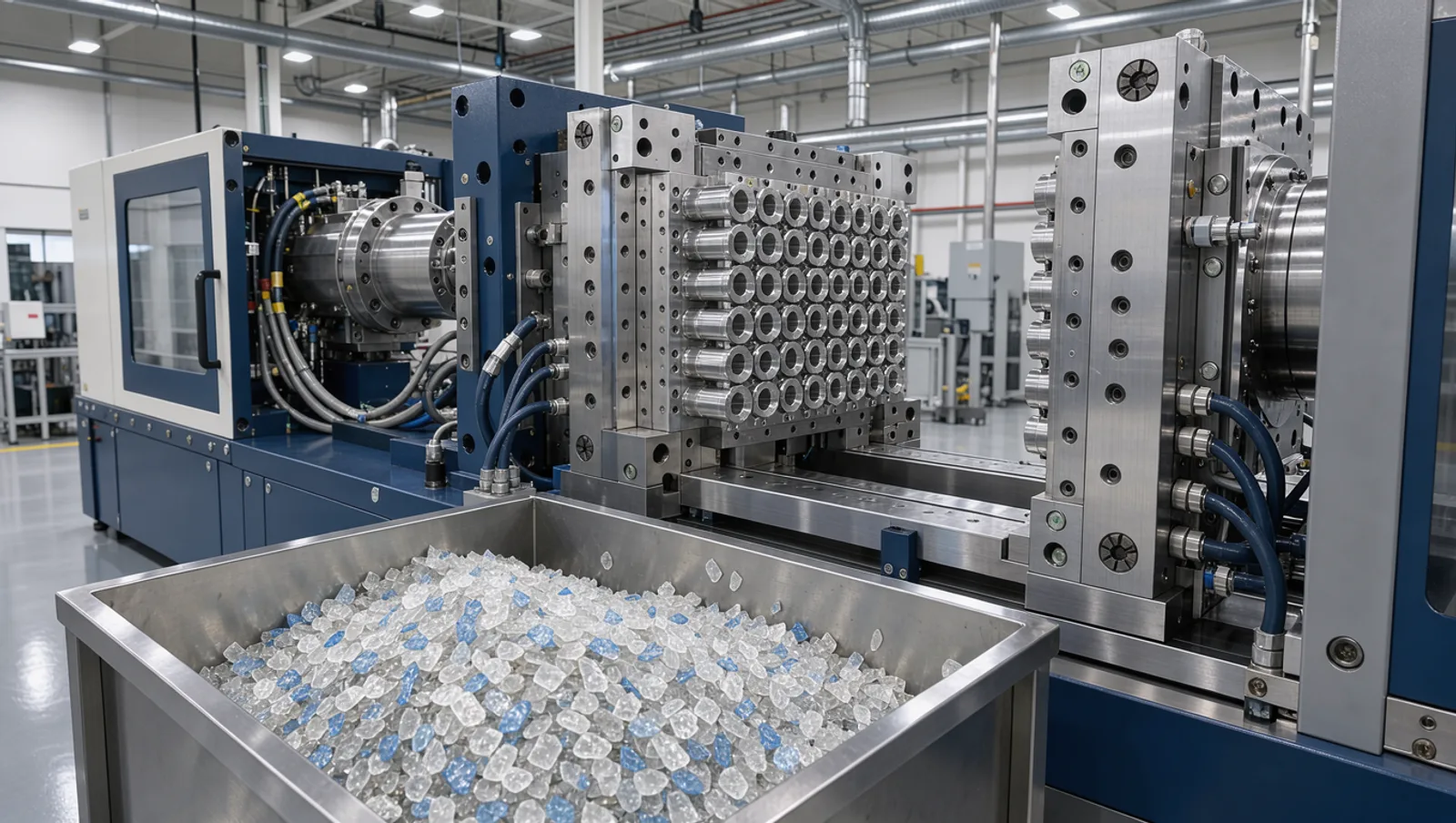
What mold and hot runner changes does a 100% rPET line need?
rPET (recycled polyethylene terephthalate) is PET recovered from used bottles and reprocessed into food-grade flakes or pellets that can replace virgin resin. In most conversions the preform mold steel and cavity layout can stay as they are; the changes concentrate on the hot runner (nozzle tips, valve pins, seals, heaters and temperature balance), on venting and cooling in the mold, and on drying and material handling in front of the machine.
The reason is that 100% rPET behaves less uniformly than virgin PET: intrinsic viscosity (IV) varies from lot to lot, the material is more sensitive to moisture and heat history, and it carries more volatiles and fine contaminants. A mold and hot runner that run well on virgin resin can show black specks, haze, gate defects and weight variation once rPET reaches 100%.
Key numbers for planning an rPET conversion
- Preform molds can be specified from 32 to 160 cavities; the conversion approach is the same, but every extra cavity adds a hot runner drop to balance.
- LIHE valve gate hot runners are available for up to 144 preform cavities, with a 3-year leakage-proof guarantee on the Husky Ultra-type design.
- Optimized mold cooling can reduce neck cooling time by up to 0.5 s, which helps recover cycle time if rPET forces a cooler, slower process.
- Lightweighting proposals reduce preform weight by 1 g to 2 g; with rPET, confirm stretch behaviour before taking weight out.
- Published lead times: replacement parts 4 weeks, pilot molds 20 days, standard PET molds 8 weeks.
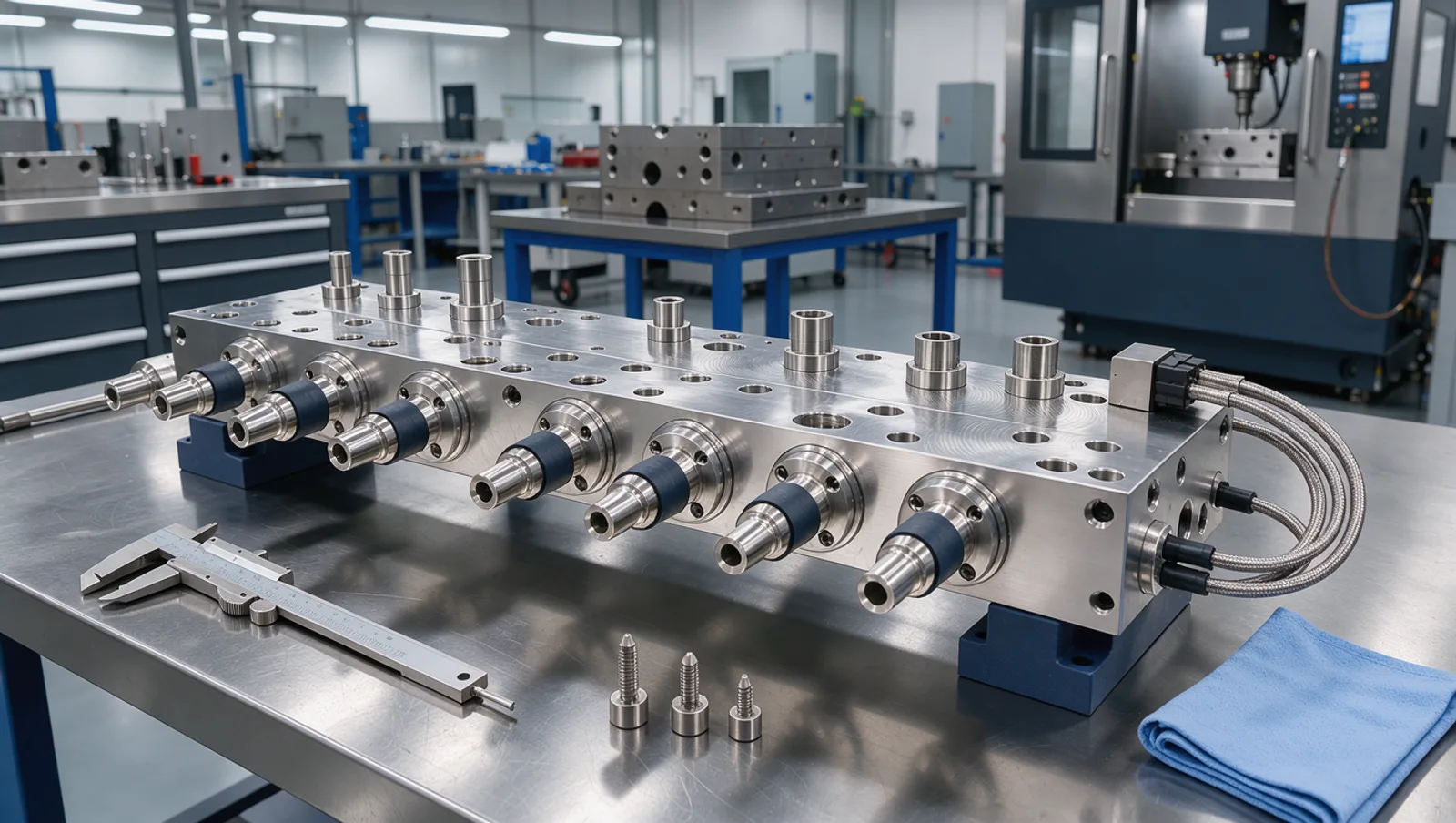
What changes when the resin becomes 100% rPET
- IV variation: recycled flake and pellet lots differ in IV, so melt viscosity, fill balance and preform weight move between lots.
- Moisture sensitivity: wet PET hydrolyses in the barrel and hot runner, which lowers IV and weakens the finished bottle.
- Heat history: rPET has already been melted at least once, so extra residence time in the manifold raises acetaldehyde (AA) and yellowing.
- Volatiles and fines: more gas and dust in the melt means faster vent fouling and deposits on cavity and core surfaces.
- Contaminants: gels, specks and foreign particles that pass the recycler's filtration can partially block nozzle tips and gates.
- Colour: rPET usually has a slight tint; haze or yellowness from the process is easier to see than with virgin resin.
What to prepare before you convert
- The rPET specification from your supplier: IV range, moisture on delivery, contamination limits and the food-contact approval of the recycling process (for example an FDA no-objection letter in the U.S.).
- Baseline data from the current virgin line: cycle time, reject rate per cavity, preform weight per cavity, AA level and IV drop from pellet to preform.
- A capacity check of the dryer and material conveying system, because rPET flake has a different bulk density and drying response than virgin pellets.
- A condition audit of the hot runner: heater and thermocouple readings per zone, nozzle tip and valve pin wear, seal condition and any leakage history.
- A condition audit of the mold: vent depth, cooling water flow and temperature difference per circuit, scale in channels and wear on neck rings and locking tapers.
- The preform and bottle drawings, plus blow molding results, so that any change to wall thickness or weight can be checked on the blow molder.
Mold and hot runner changes to consider
| Component | Typical issue with 100% rPET | Change to consider |
|---|---|---|
| Nozzle tips and valve pins | Wear, deposits, stringing and gate vestige | Inspect every drop; replace tips, pins and seals as a set where worn |
| Heaters and thermocouples | Weak zones cause cold drops and weight imbalance | Replace failing heaters and sensors; rebalance zone temperatures |
| Manifold flow channels | Dead spots hold degraded melt and release black specks | Clean or refurbish the manifold; check for hang-up points |
| Melt filtration (machine side) | Particles block gates and cause short shots | Confirm filtration upstream and on the machine with the rPET supplier |
| Cavity and core venting | Volatile deposits, burn marks, short shots | Check vent depth and set a shorter vent-cleaning interval |
| Cooling circuits | Haze and longer cooling to hold quality | Descale, verify flow per circuit, consider optimized neck cooling |
| Gate inserts | Crystalline gates, gate hole or stringing | Check gate geometry and cooling around the gate |
| Preform design | Different stretch behaviour on the blow molder | Review wall thickness and weight before lightweighting |
Step-by-step: converting the line to 100% rPET
- Step 1: Record a full baseline on virgin PET so every later change can be compared against real numbers.
- Step 2: Agree the rPET specification with your supplier and test incoming lots for IV and moisture before they reach the dryer.
- Step 3: Confirm dryer residence time and dew point capacity for the rPET throughput, following the resin supplier's drying data.
- Step 4: Service the hot runner: check every heater zone and thermocouple, replace worn nozzle tips, valve pins and seals, and clean the manifold.
- Step 5: Service the mold: descale cooling channels, check flow per circuit, clean and measure vents, and check neck rings and tapers.
- Step 6: Run a stepped material trial, increasing the rPET share in stages while measuring weight, AA, IV drop and defects per cavity.
- Step 7: Adjust process settings at each stage: melt temperature, hot runner zone balance, hold pressure and cooling, keeping residence time as low as possible.
- Step 8: Blow sample preforms on your blow molder and check bottle wall distribution, top load and appearance.
- Step 9: Lock the process window and update preventive maintenance intervals for vents, tips and filters to match rPET.
Common problems after switching to rPET and how to fix them
| Symptom | Likely cause | What to check or change |
|---|---|---|
| Black specks | Degraded melt in manifold dead spots or contamination | Clean or refurbish manifold; review filtration; reduce residence time |
| Yellowing | Excess heat history or over-drying | Lower melt and hot runner temperatures where possible; check dryer settings |
| High AA | High melt temperature and long residence time | Reduce barrel and manifold temperatures; check shot size vs barrel size |
| Haze near gate or base | Slow cooling or moisture | Check gate cooling, water flow and drying |
| Short shots in some cavities | Blocked tips, cold zones, fouled vents | Inspect tips, heaters and vents of the affected cavities |
| Stringing or long gate vestige | Worn valve pins or tips, gate too hot | Replace pins and tips; rebalance gate temperature |
| Weight variation between lots | IV variation in the rPET supply | Tighten IV specification; segregate and blend lots |
| Bubbles or splay | Moisture or volatiles | Verify drying; clean vents |
Advanced tips for stable 100% rPET production
- Measure IV on preforms, not only on incoming material; the IV drop across the line tells you whether drying and residence time are under control.
- Keep a spare set of nozzle tips, valve pins and seals on site so a blocked drop can be fixed without long downtime.
- Track rejects per cavity; a single cavity that drifts usually points to a hot runner drop, a vent or a cooling circuit, not to the material.
- Use cooling optimization to win back cycle time; LIHE's optimized cooling can cut neck cooling time by up to 0.5 s.
- Delay any lightweighting until the rPET process is stable, then test the 1 g to 2 g reduction on the blow molder.
- If the hot runner is old, compare refurbishment with a replacement; rPET exposes leakage and heater weaknesses quickly.
Related concepts
- Intrinsic viscosity (IV): a measure of PET molecular weight; it falls when PET is degraded by moisture or heat.
- Acetaldehyde (AA): a by-product of thermal degradation of PET that can affect the taste of water and sensitive drinks.
- Hydrolysis: the reaction of molten PET with water, the main reason undried material loses IV.
- Valve gate hot runner: a hot runner in which a pin opens and closes each gate mechanically, giving cleaner gates than thermal gates.
- Crystallinity: ordered regions in PET that appear as white haze in a preform when cooling is too slow.
How LIHE supports an rPET conversion
- LIHE Precision (Foshan Lihe Precision Machinery Co.,Ltd.) is a manufacturer of PET preform molds, blow molds, closure and compression molds, hot runner systems and mold components for the beverage and packaging industry, with manufacturing in Foshan, China.
- rPET material trials and production line conversions as part of custom solutions.
- Hot runner refurbishment and replacement nozzle tips, valve pins, heaters and seals for HUSKY, NETSTAL, KM and SIPA compatible systems.
- Cooling optimization and conversion parts that are 100% interchangeable with Husky, SACMI, SIPA, NETSTAL, MHT, OTTO, ASB, Krupps and Corvaglia systems.
- Remote troubleshooting, on-site start-up support and preventive maintenance by a dedicated technical team.
Frequently asked questions
- Do we need a new preform mold to run 100% rPET?
- Usually not. The cavity layout and steel can normally stay. The work focuses on the hot runner, venting, cooling and drying. A new mold is only needed if the existing mold is worn out or the preform design itself must change.
- Which hot runner parts wear fastest with rPET?
- Nozzle tips, valve pins and seals are the first parts to check, followed by heaters and thermocouples. Contaminants and deposits in rPET expose wear and weak zones faster than virgin resin.
- Why do we see more black specks after the switch?
- rPET has a longer heat history, so melt that stays in manifold dead spots degrades sooner. Cleaning or refurbishing the manifold, reducing residence time and confirming filtration usually fix it.
- Will 100% rPET make our cycle time longer?
- It can, if the process has to run cooler or slower to control AA and haze. Optimized cooling, which can reduce neck cooling time by up to 0.5 s, is one way to recover part of that time.
- Can LIHE help with trials before we commit?
- Yes. rPET material trials are part of LIHE's custom solutions, together with hot runner refurbishment and production line conversions. Contact sales@lihe-preform.com with your mold, machine and rPET details.
References
Related products
Have a mold project? Our engineers can review your requirements.
Request a Quote