
Product images have been enhanced with AI. To see the actual products, contact our sales team for photos of the machines on site.
Blow Mold for Disposable Bottled Water
Blow molds for single-use still water bottles, where bottle weight and output speed decide production cost. Bottle shape, base and grip panels are designed together with the preform for lightweight bottles that still hold their shape during filling, capping, palletizing and transport.
- Application: Still water and mineral water bottles in common sizes such as 330ml, 500ml, 550ml and 1.5L.
- Lightweight design: Base and body geometry optimized to reduce PET use while keeping top-load strength.
- Neck finishes: Matched to short-neck water preforms such as PCO 1881, 2925 and 2622.
- Machine compatibility: two-step machines: SIDEL, KRONES, SIG/KHS, TECH-LONG, NEWAMSTAR; one-step machines: SIPA, ASB, AOKI.
- High-speed production: Polished cavity surfaces and efficient cooling for stable output on high-speed rotary blowers.
Quotes and technical questions are handled directly by the manufacturer's international sales department.
Related Products
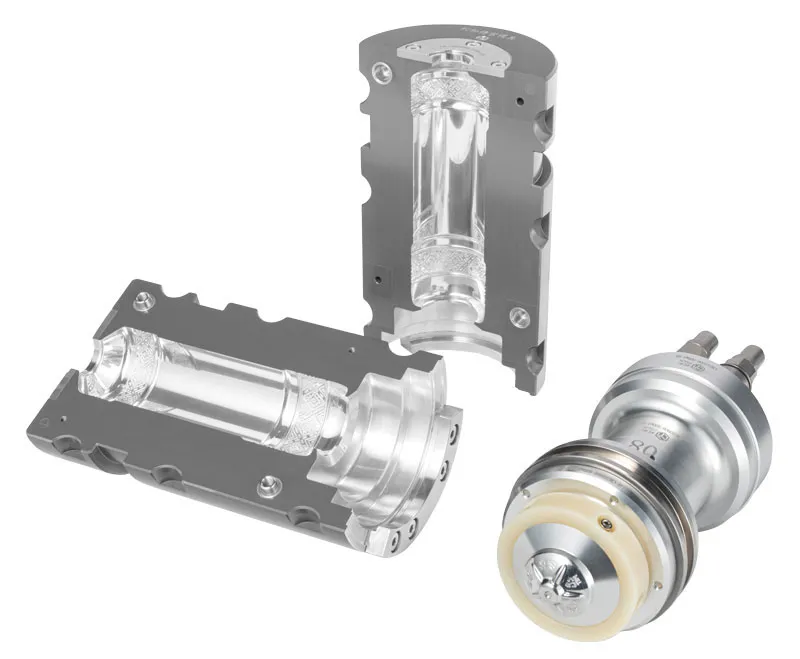
Blow Mold
PET blow molds for two-step and one-step stretch blow molding. Built for SIDEL, KRONES, SIG/KHS, TEC...
View Details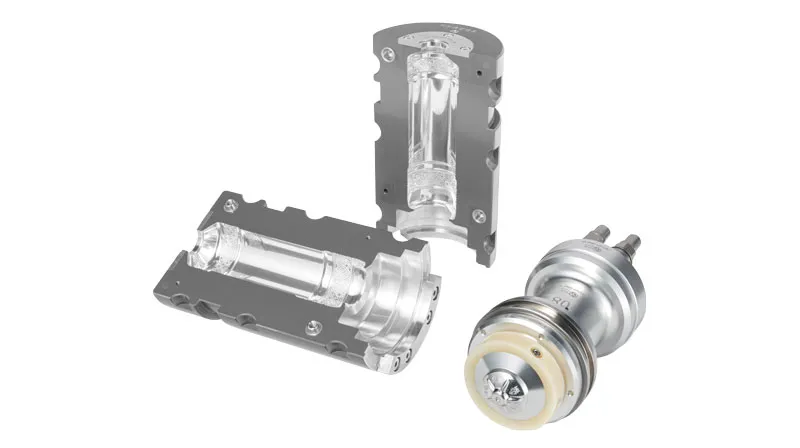
Cold Fill Blow Mold — KHS Platform
Cold fill PET blow molds built for KHS (formerly SIG) InnoPET Blomax stretch blow molders. Designed ...
View Details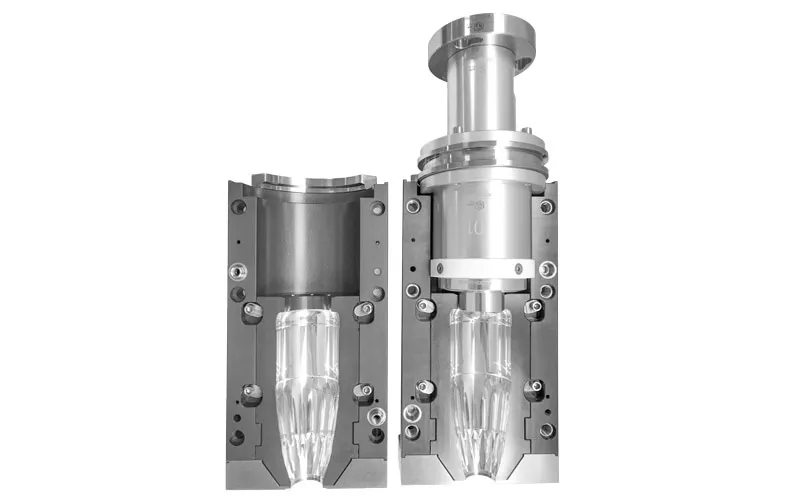
Split-Type Quick-Change Blow Mold
Blow molds with a split structure: the bottle-shaped cavity inserts are separated from the mold shel...
View Details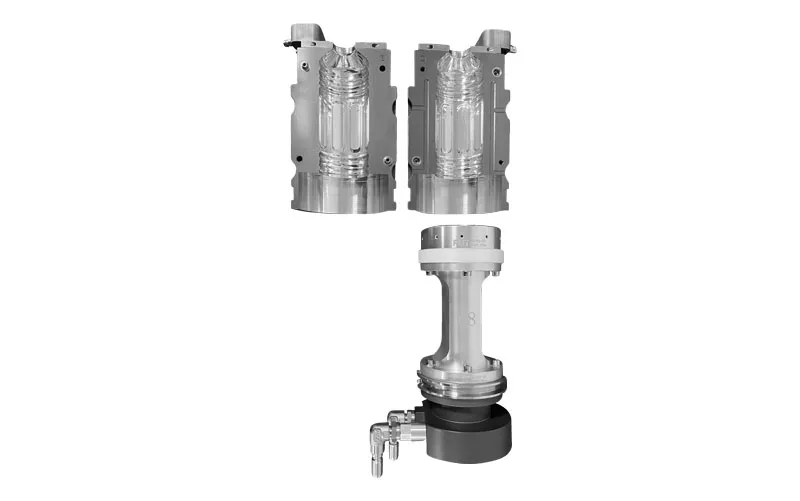
Cold Fill Blow Mold — Krones Platform
Cold fill PET blow molds built for Krones Contiform stretch blow molders. Mold shells, base molds an...
View DetailsProduct images have been enhanced with AI. To see the actual products, contact our sales team for photos of the machines on site.
Lightweight PET water bottle blow mold design for beverage production lines: base, grip panels, top-load and neck finish
A blow mold for disposable bottled water is a set of cavity halves and a base insert that stretch-blows a heated PET preform into a single-use still water bottle. This guide explains the design choices that decide how light a water bottle can be and still survive the line and the pallet: base shape, grip panels, top-load strength, neck finish and bottle size. It ends with the development steps from bottle drawing to approved samples.
What makes a lightweight water bottle work
In still water, the bottle carries no internal pressure after capping, so the main loads are vertical: the capper pushing down, stacked cases and pallets, and handling by the consumer. A lightweight bottle works when the PET that remains is placed where these loads act and removed where it does nothing.
Bottle weight is set by the preform, but where the material ends up is set by the blow mold geometry and the stretch ratios between preform and bottle. For that reason the bottle and the preform should be designed as one pair, not ordered separately.
- Material distribution: aim for even wall thickness in the shoulder, panel and heel; thick spots add weight without adding strength.
- Shoulder geometry: a well-shaped shoulder carries most of the top-load from the neck down into the body.
- Base geometry: the base must stand flat after filling and resist rocking on conveyors.
- Neck finish: the finish is one of the heaviest parts of the preform and is a direct lever on weight.
- LIHE lightweighting proposals reduce preform weight by 1g to 2g through neck or wall-thickness optimization, and the blow mold is adjusted to match the new preform.
Water bottle base design: petaloid vs flat and push-up bases
The base is where blow molding is hardest: material stretches least near the gate, and the base must stand stable on fast conveyors. The right base depends on whether the product is still or carbonated.
- Use a flat or push-up base for standard still water unless the line uses nitrogen dosing or the product is carbonated.
- Keep the standing ring wide enough to prevent tipping on transfer points and in conveyor accumulation.
- Check base clearance with the filler and capper handling parts before freezing the design.
| Petaloid base | Flat / push-up (champagne-style) base | |
|---|---|---|
| Shape | Several feet ("petals") around a central gate area | Flat standing ring with a domed push-up in the center |
| Main purpose | Resists internal pressure from carbonation | Stable standing for non-pressurized products |
| Typical water use | Sparkling water and some nitrogen-dosed still water lines | Most still water and mineral water bottles |
| Material needs | More material in the feet and valleys | Can be blown thinner because there is no internal pressure |
| Main risks | Thin or stress-cracked feet if material is short | Base roll-out or rocking if the push-up is too shallow |
Grip panels, ribs and top-load strength
Top-load is the vertical force a bottle withstands before it buckles. It is tested on empty and filled bottles because both conditions occur on the line: empty bottles meet the capper and filler, filled bottles meet the pallet stack.
- Horizontal rings and ribs increase hoop stiffness, which helps bottles keep their shape when squeezed, but rings placed too close to the shoulder can lower top-load.
- Grip panels give the consumer a place to hold a thin bottle; they should be shallow and smooth so material can flow into them evenly.
- Label panels must stay smooth and round enough for the label to apply without wrinkles.
- Sharp corners and deep features trap material and leave thin walls next to them; generous radii distribute PET more evenly.
- Very light still water bottles are often filled with a small dose of liquid nitrogen so internal pressure adds rigidity; the bottle design must allow for that pressure.
- Confirm top-load targets with the filler, capper and pallet pattern you actually use, not with a general figure.
Neck finish choice for water bottles: PCO 1881, 2925 and 2622
The neck finish fixes the closure, the preform weight in the threaded area and the neck handling parts on the blow molder and filler. Changing it later affects the preform mold, the closure supply and the conveyor parts, so it is decided at the start.
- Short water necks such as 2925 and 2622 save material in the neck compared with taller finishes.
- If the line also runs carbonated drinks, a shared PCO 1881 finish can keep closures and neck parts common.
- The preform mold, the blow mold neck area and neck grippers must all match the chosen finish.
| Neck finish | Nominal size | Typical water use | Points to check |
|---|---|---|---|
| PCO 1881 | 28 mm | Still and sparkling water; shared with carbonated soft drink lines | Heavier than short water necks; useful when one line runs both still and carbonated products |
| 2925 (29/25) | 29 mm | Still water with short, lightweight closures | Closure supply and capping heads must match the 29 mm finish |
| 2622 (26/22) | 26 mm | Still water where the lightest neck is wanted | Smaller opening; check closure availability and capper tooling |
Water bottle sizes: 330ml, 500ml, 550ml and 1.5L
- 330ml: short bottles where base stability and label area matter; often used for events, hotels and multipacks.
- 500ml: the most common single-serve size; the main target for lightweighting because volumes are high.
- 550ml: a variant of the 500ml format used in some markets; it may share the preform with 500ml if the stretch ratios allow it.
- 1.5L: larger panels and longer bodies need more attention to top-load and paneling; grip areas help the consumer pour.
- Producing several sizes from one preform reduces preform mold investment but must be checked for correct stretch ratios in each bottle.
- LIHE supplies water bottle blow molds in these sizes for two-step machines (SIDEL, KRONES, SIG/KHS, TECH-LONG, NEWAMSTAR) and one-step machines (SIPA, ASB, AOKI).
Development steps for a new lightweight water bottle blow mold
- Step 1: Define the product: size (for example 500ml), still or carbonated, nitrogen dosing, target bottle weight, closure and neck finish.
- Step 2: Collect line data: blow molding machine model, mold carrier type, filler and capper handling parts, label size and pallet pattern.
- Step 3: Draw the bottle and preform together; LIHE's engineering center uses CAD/CAM, 3D simulation and flow analysis before production.
- Step 4: Review the drawing with the bottler: shape, base, grip panels, label panel and brand features.
- Step 5: Machine the blow mold and, where needed, a matching preform or neck parts.
- Step 6: Blow sample bottles and inspect them: wall thickness distribution, volume, base shape and dimensions; LIHE checks samples with a 3D profile scanner and bottle sample inspection.
- Step 7: Test top-load and stability with the bottler's own filling and capping conditions, adjust the design if needed, and approve for production.
What to send when requesting a water bottle blow mold quote
- Bottle drawing or sample, or a sketch with size, height and diameter limits.
- Preform drawing or sample, including the neck finish (PCO 1881, 2925, 2622 or other).
- Machine brand and model, number of cavities and mold carrier type.
- Target bottle weight, and whether the project is a new bottle or a lighter version of an existing one.
- Filling type (still, sparkling, nitrogen dosed) and any label or pallet constraints.
Frequently asked questions
- Can an existing water bottle be made lighter without changing the filler?
- Often yes. Lightweighting usually changes the preform weight and the blow mold geometry while keeping the neck finish and the outer dimensions that the filler, capper and labeler handle. LIHE lightweighting proposals reduce preform weight by 1g to 2g through neck or wall-thickness optimization.
- Which base is better for still water, petaloid or flat?
- For non-pressurized still water a flat or push-up base is usually enough and uses less material. A petaloid base is designed to resist internal pressure, so it is used for sparkling water and some nitrogen-dosed still water bottles.
- Should I choose PCO 1881 or a short water neck like 2925 or 2622?
- Short water necks save material and suit lines that only run still water. PCO 1881 is a common choice when the same line also fills carbonated drinks, because closures and neck handling parts can be shared.
- Can 500ml and 550ml bottles use the same preform?
- Sometimes. It depends on the stretch ratios between the preform and each bottle. The bottle and preform drawings should be checked together before deciding to share one preform.
- Which blow molding machines are these molds made for?
- Two-step machines such as SIDEL, KRONES, SIG/KHS, TECH-LONG and NEWAMSTAR, and one-step machines such as SIPA, ASB and AOKI. The machine model and mold carrier type are needed with the request.