
Product images have been enhanced with AI. To see the actual products, contact our sales team for photos of the machines on site.
Hot Fill Blow Mold
Heat-set PET blow molds for bottles filled hot at around 85–95°C, such as juice, tea drinks and isotonic beverages. Standard PET bottles deform above about 60°C; heated mold walls crystallize and stabilize the bottle during blowing, and vacuum panels in the bottle design absorb the pressure drop as the product cools.
- Filling type: Hot fill for juice, tea, isotonic drinks and other products filled at about 85–95°C.
- Heat-set process: Mold shells with heating channels for hot oil circulation, with separate temperature control of body and base.
- Bottle design: Vacuum panels, reinforcing ribs and base geometry to keep the bottle stable after filling and cooling.
- Machine compatibility: Heat-set versions of mainstream two-step rotary blowers, including SIDEL and KRONES.
- Material and finish: Mold material and cavity finish chosen for long-term operation at elevated temperature.
Quotes and technical questions are handled directly by the manufacturer's international sales department.
Related Products
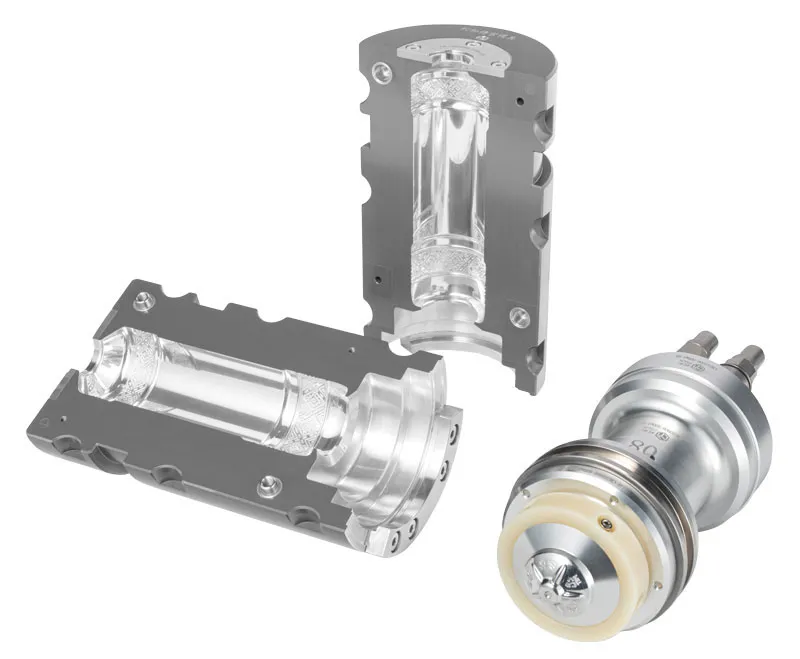
Blow Mold
PET blow molds for two-step and one-step stretch blow molding. Built for SIDEL, KRONES, SIG/KHS, TEC...
View Details
Cold Fill Blow Mold — KHS Platform
Cold fill PET blow molds built for KHS (formerly SIG) InnoPET Blomax stretch blow molders. Designed ...
View Details
Blow Mold for Disposable Bottled Water
Blow molds for single-use still water bottles, where bottle weight and output speed decide productio...
View Details
Split-Type Quick-Change Blow Mold
Blow molds with a split structure: the bottle-shaped cavity inserts are separated from the mold shel...
View DetailsProduct images have been enhanced with AI. To see the actual products, contact our sales team for photos of the machines on site.
Hot fill blow mold operation and maintenance: hot oil circuits, temperature zones, vacuum panels and bottle defects
A hot fill (heat-set) blow mold is a PET blow mold whose shells are heated by circulating hot oil so that the bottle is crystallized and stress-relieved during blowing and can be filled at about 85–95°C. Standard PET bottles deform above about 60°C, so the mold's temperature control, the bottle's vacuum panels and the filling conditions must work together. This guide covers how the hot oil circuits and temperature zones are run, how vacuum panels are designed, start-up and shutdown practice, the common hot fill bottle defects with what to check, and routine maintenance.
Hot oil circuits in a heat-set blow mold
In a cold fill mold, water removes heat from the bottle as fast as possible. In a heat-set mold the shells are deliberately held hot, so the PET stays at an elevated temperature against the cavity wall long enough to crystallize and relax the stress from stretching. A heat transfer oil is used because it can carry heat at mold temperatures where water would need a pressurized system.
- A temperature control unit on the machine heats the oil and pumps it through channels in each mold shell.
- Channels run close to the cavity and follow its shape, so the whole bottle wall reaches the same heat-set condition.
- Hoses, couplings and seals in the circuit must be rated for hot oil; ordinary water hoses and seals are not suitable.
- Thermal insulation between the hot shells and the mold carrier limits heat flow into the machine.
- All stations are supplied from the same system and must reach the same temperature, otherwise bottles from different stations behave differently on the filler.
- The machine itself must be a heat-set version; LIHE builds hot fill molds for heat-set versions of mainstream two-step rotary blowers, including SIDEL and KRONES.
Body and base temperature zones in a hot fill blow mold
The body and the base of a hot fill bottle need different treatment, so the mold has separate temperature control of body and base. Actual set points are given by the machine maker and fine-tuned on trial bottles; the table shows what each zone does.
| Zone | Role in the heat-set process | Typical symptom when it is out of balance |
|---|---|---|
| Body shells | Held hot by oil to crystallize and stabilize the sidewall, shoulder and vacuum panels | Shrinkage, volume loss or panel distortion after hot filling |
| Base mold | Controlled separately so the thicker base forms fully and stays stable after release | Base roll-out, rocking bottles or a deformed standing ring |
| Neck area | Not blown; the preform neck keeps its injection-molded shape, and some hot fill bottles use a crystallized neck finish | Neck ovality or closure leaks after capping hot product |
| Bottle interior at release | Cooled, typically by flushing air through the bottle, before the mold opens | Bottle deforms or sticks when it leaves the hot mold |
Vacuum panel design for hot fill PET bottles
After capping, the hot product and the headspace cool and contract, which creates a vacuum inside the bottle. Vacuum panels are areas designed to move inward in a controlled way so the rest of the bottle keeps its shape. The panels are formed by the shape of the mold cavity, so their design is part of the mold design.
- Panels are usually placed in the label area, where the label covers their movement and supports the bottle.
- Panels are spaced evenly around the bottle so it pulls in symmetrically and does not become oval.
- Ribs and frames around the panels keep the shoulder and base rigid while the panels flex.
- Some designs let the base take part of the vacuum, which reduces the panel area needed in the sidewall.
- Panel edges and ribs need good venting in the mold so they form sharply; soft edges change how the panel flexes.
- Square and round hot fill bottles both use this principle; the panel layout follows the bottle cross-section.
Start-up and shutdown of a hot fill blow mold
- Step 1: Before start-up, inspect hot oil hoses, couplings and seals on every station and check the oil level in the temperature control unit.
- Step 2: Heat the molds to the set points for body and base and wait until every station is stable at temperature before blowing.
- Step 3: Blow the first bottles and check appearance, base shape and wall distribution from each station.
- Step 4: Run a hot fill test on sample bottles at the actual filling temperature of the line, cap and cool them, then measure volume and check panel and base movement.
- Step 5: Release production only when bottles from all stations pass the hot fill test.
- Step 6: At shutdown, stop the preform feed first and keep oil circulating while the molds cool down under the control unit's program.
- Step 7: Disconnect hot oil couplings only when the mold is cool enough to handle, and cap them to keep out dirt and moisture.
Common hot fill bottle defects and what to check
| Defect | What to check on the mold and process |
|---|---|
| Bottle shrinks or loses volume after filling | Body shell temperature reached on all stations; heat-set time; actual fill temperature compared with the design |
| Uneven or permanent panel collapse | Panel geometry and wall thickness at the panels; venting of panel edges; symmetry of the material distribution |
| Bottle becomes oval | Equal temperature on both shell halves; balanced panel layout; preform heating profile |
| Base roll-out or rocking bottle | Base mold temperature control; material in the base; base cooling before release |
| Neck finish distortion or leaking closure | Neck finish type suitable for hot fill; neck plate fit; capping conditions |
| Bottle sticks or deforms at release | Cooling of the bottle interior before the mold opens; cavity surface condition |
| Haze or white areas in the wall | Preform heating and stretch conditions; uneven temperature along the shell |
Maintenance checklist for heat-set blow molds
- Check hot oil couplings and seals for leaks at every shift; oil on the cavity or parting line marks bottles and is a burn and fire risk.
- Replace hoses and seals that are hard, cracked or swollen, and follow the temperature control unit maker's schedule for oil condition.
- Inspect thermal insulation between the shells and the mold carrier and replace damaged insulation.
- Clean vent slots and holes, especially around vacuum panels and base features.
- Check parting line faces and locating features for wear, because heating and cooling cycles add stress to these areas.
- Clean and protect cavity surfaces according to their finish; the material and cavity finish are chosen for long-term operation at elevated temperature.
- Keep spare base molds and seals for high-volume formats; replacement parts have a published lead time of 4 weeks, and mold refurbishment programs are available.
Frequently asked questions
- Can a cold fill blow mold be converted to hot fill?
- Generally not. A heat-set mold needs hot oil channels, separate body and base temperature control, insulation from the carrier and a bottle design with vacuum panels, and it must run on a heat-set version of the blow molder. In most cases a new mold set is designed for hot fill.
- What filling temperature should we give when ordering?
- Give the actual filling temperature and its tolerance on your line, the product and the cooling method after filling. Hot fill molds are designed for products filled at about 85–95°C, and the design is checked with a hot fill test at your real conditions.
- Why do hot fill bottles need vacuum panels?
- When the hot product cools in the closed bottle, it contracts and creates a vacuum. Without designed panels the bottle would collapse or distort in random places. Panels move inward in a controlled way so the bottle keeps its shape and label area.
- Can hot fill bottles be lightweighted like water bottles?
- Within limits. The heat-set structure, panels and ribs need enough material to stay stable after filling, so weight reduction is checked carefully with hot fill tests on trial bottles. Preform and bottle design are adjusted together.
- Which blow molding machines do your hot fill molds fit?
- Heat-set versions of mainstream two-step rotary blowers, including SIDEL and KRONES. Send the machine model and generation so the mold fits the carrier and the hot oil connections.